

Illustration: Dave O’Malley
Part Two of a Three-Part Story
In the Second World War, the Dubroy family of Ottawa lost four sons (two sets of cousins), all of whom died on operations with Bomber Command, yet only three of them were aviators. Part One of the story, the death of young Billy Dubroy of Cartier Street, can be found HERE.
The Grim Work of finding the lost
It was late August 1946, more than a year after the Second World War had ended in Europe, but Flight Lieutenant W. H. “Bill” Armstrong of the Royal Air Force still felt decidedly uncomfortable walking alone down Reichstaße in the tiny Hamlet of Jakobidrebber, Lower Saxony. It seemed everyone had gone to ground. Perhaps they were keeping warm indoors, for it had been raining for days and the temperatures had hovered below 20°C for weeks. Or perhaps they simply didn’t want to get involved. Overall, it had been an unseasonaly cool and unsettled month, following a severely cold, wet, and often dull June and an even wetter July. It made his work more depressing and difficult than it already was. Exhumation was grim work at the best of times, but in this never-ending drizzle, the rain-soaked ground gave up the dead reluctantly.
Armstrong didn’t necessarily love this line of work, but he had volunteered for it out of a sense of duty to help find fallen airmen like some of his pals on squadron who never returned. And it was safer than anti-shipping operations, that’s for sure. Before joining, he served as an RAF navigator on Beauforts and Beaufighters on anti-shipping operations on Malta and in Italy during the war. Because he was fluent in German, he was an ideal fit to lead a section of the post-war research units deployed to German soil to locate missing Allied aircrews and identify unknown graves. Following cessation of hostilities, Armstrong was posted No. 4 Missing Research and Enquiry Unit (4 MREU), a specialized unit of the larger Missing Research and Enquiry Service (MRES). Both the MREU and the MRES were responsible for investigating the fates of Allied aircrew listed as "missing, believed killed" around the globe. No. 1 MREU operated in France, No. 2 in Belgium, The Netherlands and Czechoslovakia, No. 3 in Norway and Denmark, No. 4 in Germany and Poland, and No. 5 in the Mediterranean and the Middle East. He had no special training or tools, just a notebook, a Jeep to get around in and a strong desire to find and identify those who had not returned.
Earlier that morning he had visited the Kreis Diepholz District Office a few kilometres to the southwest to speak to two officials from the Geundhaitswesen, the healthcare section. The District Office had dutifully submitted to the MREU a list graves of Allied airmen who were shot down and killed in the Diepholz District during the war, which confirmed the burial details of the two airmen who were the subjects of his investigation. The officials knew little about the aircraft that had crashed here on Riechstaße or the men whose bodies were recovered from its wreckage 17 months previously. They, however, did produce copies of the death certificates for a number of Allied airmen. these certificates had been issued at the time of the deaths by medical officers from Flughafen Diepholz, the nearby Luftwaffe airfield where night-fighters had been based towards the end of the war. It was Luftwaffe personnel at Diepholz who looked after the salvage of wreckage, recovery of remains and the proper recorded burial of Allied airmen killed in the vicinity of the city of Diepholz. Armstrong had no love for the Luftwaffe, but he had to admit they kept good records.
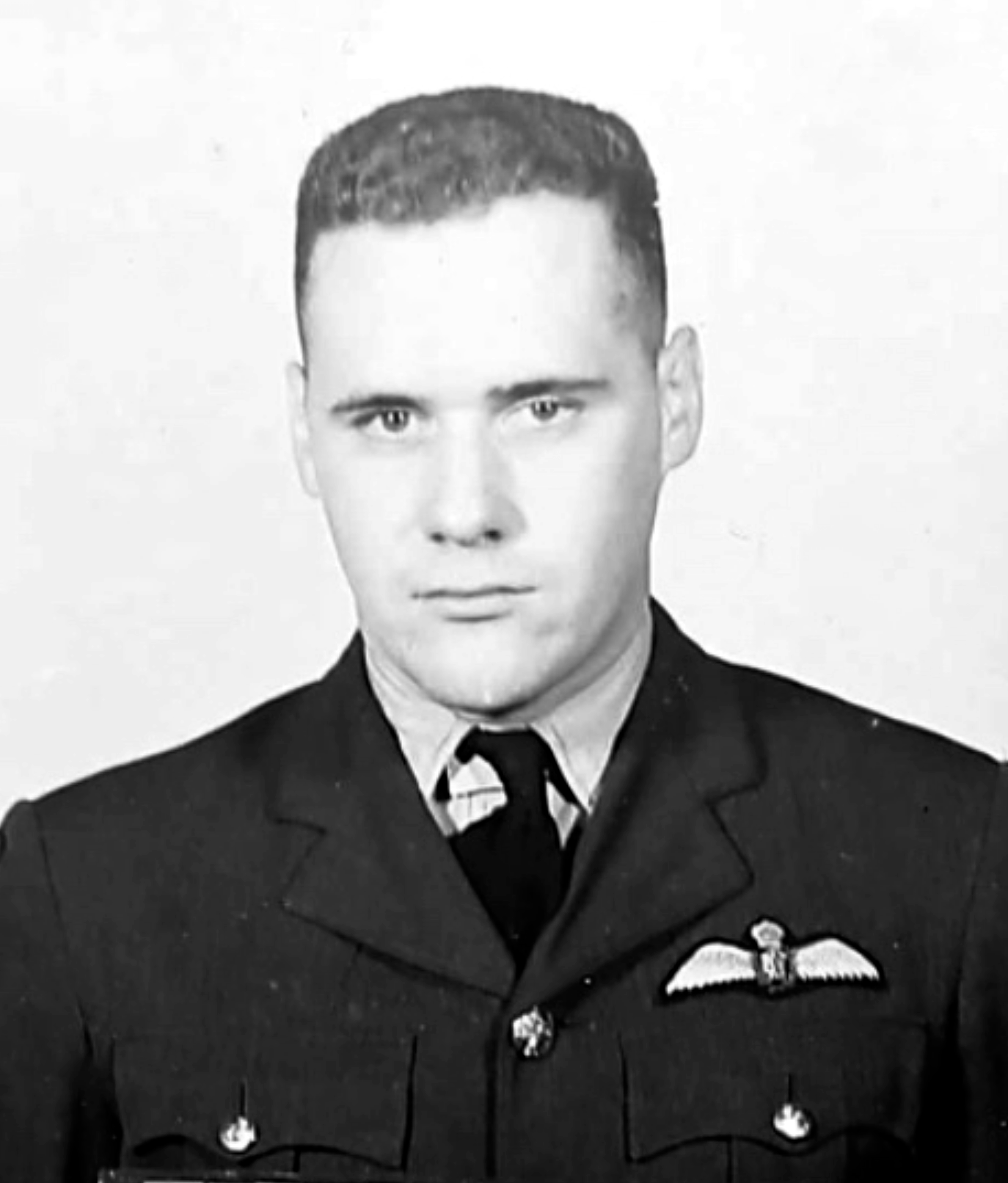
Flight Lieutenant Thomas Edmond Dubroy, Royal Canadian Air Force. Photo via RCAF service file
Those records indicated that the remains of two airmen from the crash of a de Havilland Mosquito at 51 Reichstraße in Jakobidrebber were buried together in the same casket in Wetscher-Wiesen Friedhof, a military cemetery for enemy casualties near Diepholz. With the help of two men from the British Army’s 39 Graves Concentration Unit (39 GCU was tasked with locating, exhuming, and concentrating scattered war dead into established military cemeteries), they exhumed the two bodies and separated them. From their flying badges and full names and initials written on articles of clothing they positively identified the remans as those of RCAF Flight Lieutenant Thomas Edmund Dubroy of Ottawa and 21-year-old Royal Air Force Volunteer Reserve Flying Officer Frederick William Dalzell Haynes of High Wycombe, Buckinghamshire. After their careful and respectful inspection, the three men reburied them separately in blankets so that later, No. 39 GCU could transfer them to a nearby military cemetery.
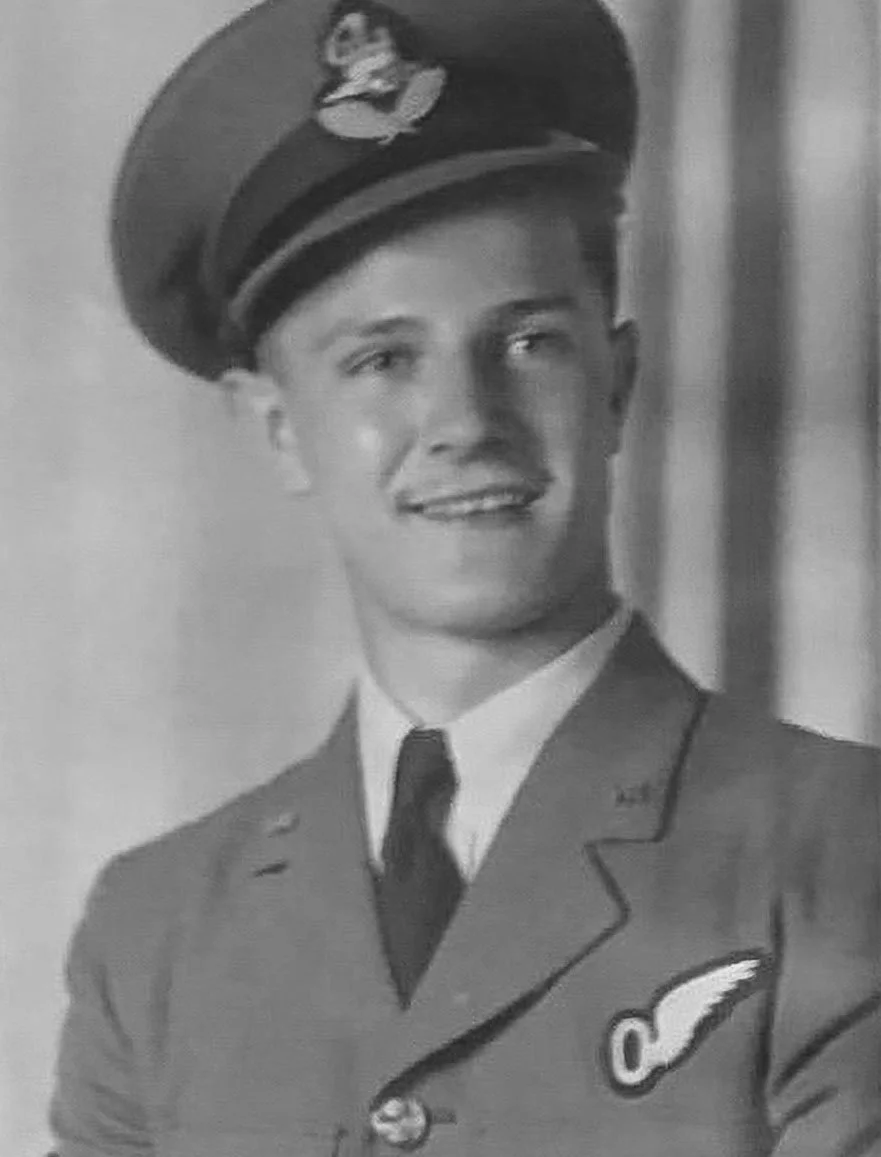
Flying Officer Frederick William Dalzell Haynes, Royal Air Force Volunteer Reserve. Photo discovered by Richard Mallory Allnutt on eBay.
Before writing up his final report, he needed to visit the place where they died to confirm the connection between their bodies and this particular known crash site at 51 Reichsstraße, Jakobidrebber, the date of which coincided with their disappearance. He had interviewed the present Burgermaister Herr Ihlbruck and his predecessor Herr Risch who told him what they knew of what happened on the night of January 29, 1944, which wasn’t much. Herr Risch explained that around 2 AM on that cold January night, an aircraft was seen approaching Jakobidrebber from the north. It was on fire, lighting up the night sky and losing altitude rapidly. Perhaps the pilot was blindly feeling for a landing spot in the blacked-out darkness that surrounded the village. After crossing the village’s western edge, the pilot made a left turn to the east, streaming flame across the south end of a small cluster of homes and barns, as if letting down for a crash landing. The burning aircraft, engines shrieking, struck the roof of a house and a tree and then crashed in the field beyond coming to rest up against the embankment of Reichsstraße. There was no explosion, no exit of the crew, nothing but wood, glycol and oil from the aircraft burning throughout the night.
In the morning light, there was nothing the weary citizens of Jakobidrebber could do for Dubroy and Haynes except wait for the Luftwaffe party from Flughafen Diepholz to arrive and collect up the pieces of their smashed and burned bodies. The site was secured by police, and the remains removed later that same day. The next day, Luftwaffe lorries arrived to collect the wreckage for salvage. The usable remains were mostly the two Merlin engines, for the aircraft was made largely of wood that had been consumed in the fire.
Armstrong found No. 51 and descended the road embankment and stood looking around him for any clues that might tell him what kind of aircraft crashed here that night. Walking parallel to the roadway, he toed a small piece of what looked like plywood, squatted down next to the face of the embankment and pulled the piece from the dirt. He’d seen this material before. Two layers of three-ply birch veneers with a lightweight Ecuadorian balsa core. It was noticeably curved, painted faded and scuffed black on the outer side and partially burned. There were a few other pieces of shaped wood, all of them small, a few lengths of charred and twisted wire. He placed them in his satchel and stood up, trying to imagine the young Canadian Dubroy struggling to maintain control of his dying aircraft. Standing there he turned to the northwest, imagining the approaching aircraft that night, pictured the turn to starboard and in his mind, he saw them strike the roof of the house on the other side of the field. He saw the light from the burning aircraft illuminate the field before it struck. He sighed heavily.
The uniquely sandwiched pieces of wood in his satchel were used for only one thing; to build a de Havilland Mosquito fighter bomber. He knew beyond a shadow of doubt now that a Mosquito had crashed here that night. There was no other recored losses of Mosquitos in this area during the war, so Armstrong made the simple deduction that the remains of the two men he had exhumed were most likely from the crew of this Mosquito — HJ722 of 418 Squadron, Royal Canadian Air Force.
Thomas Edmund Dubroy
Tommy Dubroy was born on October 22, 1917, to Annie McKenna and William Dubroy at the Ottawa Maternity Hospital on Ottawa’s Rideau Street. The family lived in the tint farming community of Dwyer Hill, Ontario, southwest of Ottawa. Tommy was the third child of six: Wilfred Joseph (born 1908), Francis Lawrence (1912), Joseph “Billy” William (1921) and two sisters Nora Mary (1909) and Helen Margaret (1913). He was destined to be a powerful athlete and a high-performing student.
The family eventually moved to Ottawa where his father, William Dubroy took a job as a streetcar conductor for the Ottawa Electric Railway. They lived in a humble frame house at number 109 Cartier Street in downtown Ottawa, just a few blocks from Parliament Hill. He attended St. Patrick’s elementary school on Nepean Street, across from St. Patrick Basilica. Though school was close to the glorious basilica, the family were members of St. Theresa Church, just a few blocks from their home.
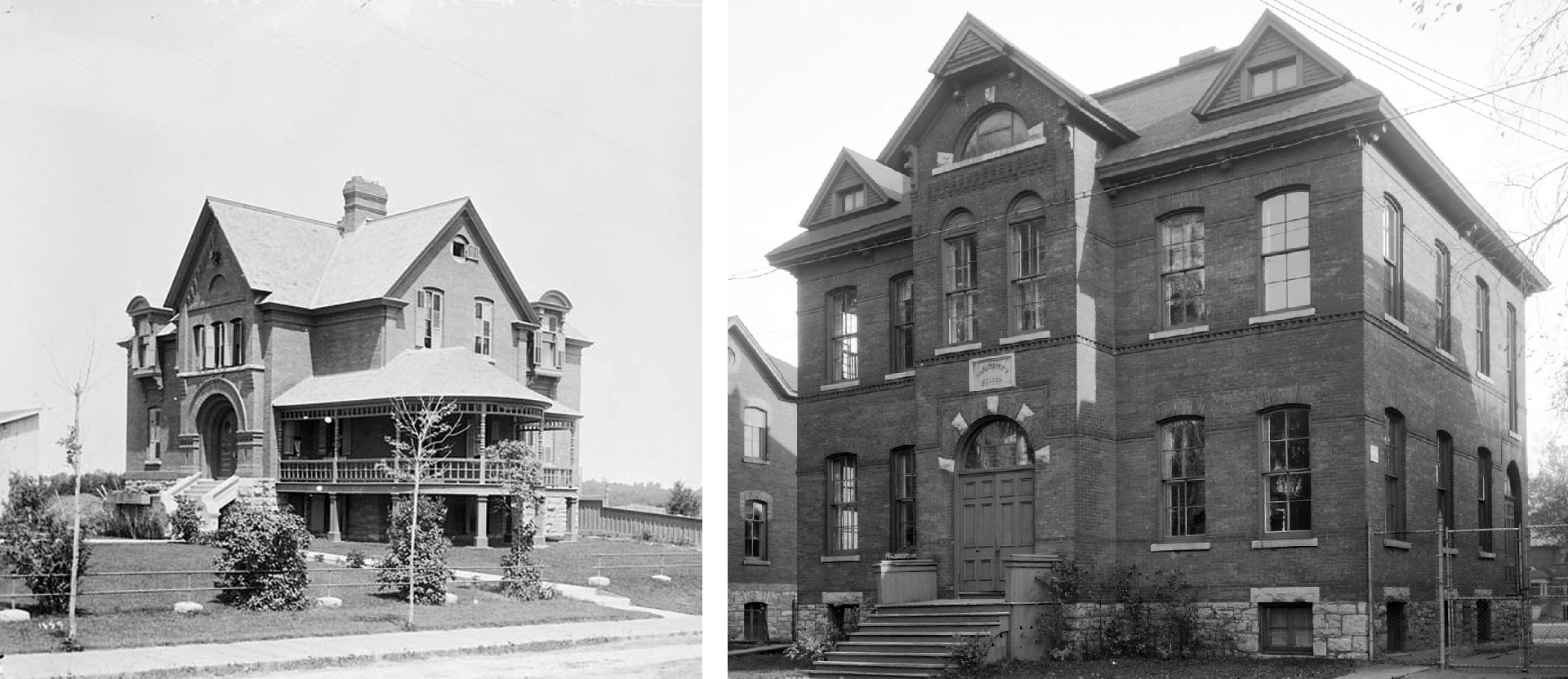
As with so much of Ottawa’s Victorian past, the buildings of Tommy Dubroy’s young life no longer exist. Dubroy came into the world at Ottawa Maternity Hospital (right) at the eastern end of Rideau Street in Ottawa. While it looks like a posh home of one of Ottawa’s lumber barons, it was purpose-built for $18,000.00 as a maternity hospital—perhaps to provide mothers a sense of homeliness. He attended St. Patrick’s Separate Elementary on Nepean Street near Kent. The school was demolished in the 1950s and the Maternity Hospital operated until 1924.
In 1930, Tommy Dubroy enrolled at Lisgar Collegiate Institute, which was just a few blocks north of their Cartier Street home. Lisgar was, and remains today, Ottawa’s oldest secondary school. Several hundred of its alumni were killed in the two world wars. At Lisgar, Tommy’s athletic career took off. He was a member of the school rugby football, rowing and ski teams, excelled at them all and played them “intensively” as he wrote in his attestation papers when he enlisted. In those days, skiing and rowing were the sports played by the sons and daughters of affluent families who could afford the membership in Ottawa’s sporting clubs and the equipment needed. But Lisgar’s sports programs gave Tommy access to sports the son of a streetcar conductor ordinarily would not play.
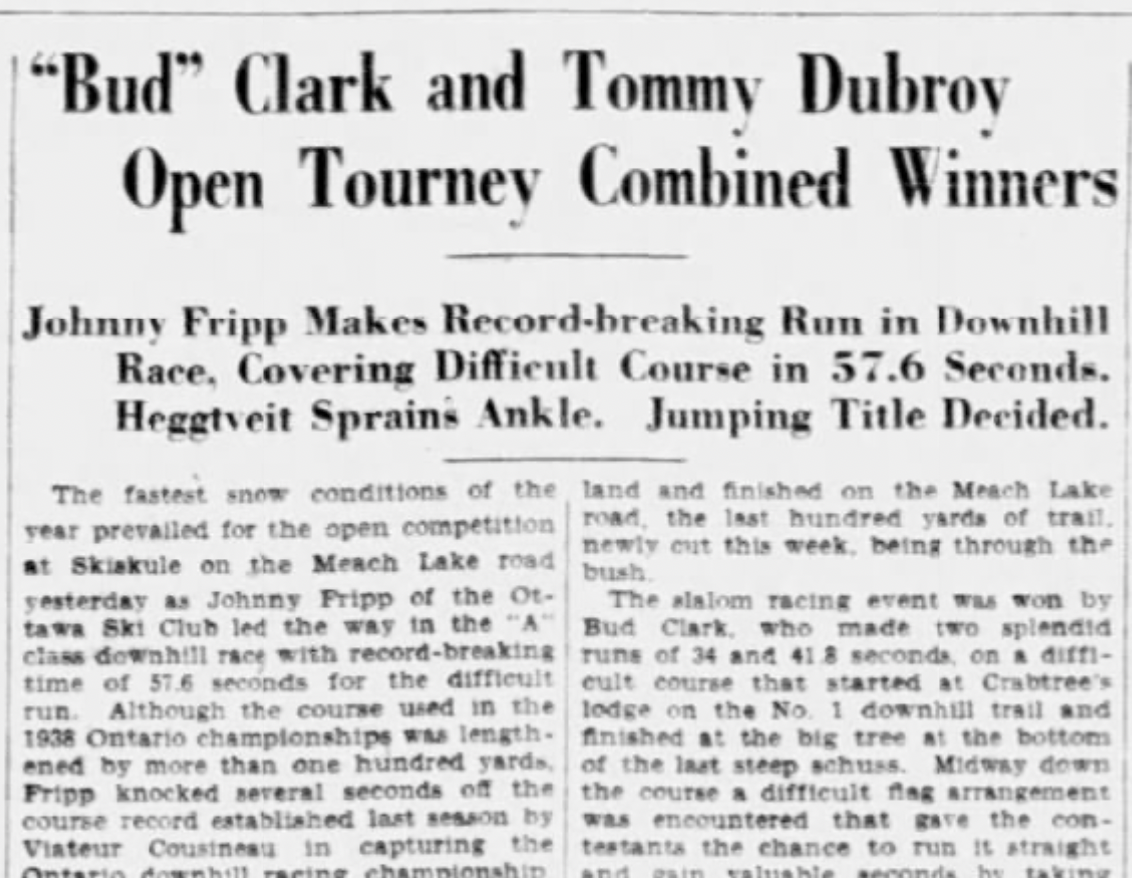
A prewar newspaper clipping that reveals Tommy Dubroy’s reputation as a star athlete, particularly in skiing. The headlines contain names that are still well known to this day in skiing circles here in Ottawa. Both “Bud Clark” and “Heggtveit” are the names of challenging double black diamond runs at Camp Fortune ski hill just minutes from Ottawa. And the Fripp family has long been royalty in Ottawa skiing circles. Both Johnny Fripp and Bud Clark are members of the Canadian Ski Hall of Fame. Heggtveit’s sister Anne is also in the Hall. Dubroy Image via Newspapers.com
Tommy Dubroy loved to fly — down the slopes, on the river, on the football field, or in the air. As early as 1935 his name appears as a competitor in The Southam Cup, an interscholastic ski competition on the slopes of Camp Fortune a few kilometres north of Ottawa in the Gatineau Hills. He was just 17 years old, good and getting better. By the following year, he placed second with the team from Lisgar Collegiate Institute. A year later he led the field in the individual combined events (ski jump, cross-country and slalom), having competed against and beat such early Ottawa ski luminaries as Bud Clark, John Fripp and the Heggtveit brothers (uncles of Olympic Gold Medalist Anne Heggtveit). Both Clark and the Heggtveits have ski runs at Camp Fortune named after them. Tommy Dubroy, had he lived, might have had one too, but the crash of Mosquito HJ722 would put an end to that.
Following high school in 1937, he took a job as a law clerk at the law firm of Aylen and MacLaren at 48 Sparks Street at the corner of Elgin Street. He must have had a bird’s eye view of King George VI and Queen Elizabeth unveiling of Canada’s National War Memorial on May 21, 1939, as that address is but a few yards from the memorial. At night, he continued to better himself, taking bookkeeping, typing and shorthand courses at Stephen Willis College of Commerce at 62 Bank Street. Willis College, which started in Ottawa in 1866, gave men and women a leg up to qualify for a civil service position, still operates today with campuses in Ottawa and Winnipeg. In addition to his night school studies and daytime work he also joined the Royal Canadian Mounted Police as a Reserve Constable at N-Division, Rockcliffe, but perhaps that was just too much to take on for he left after two months.
When war was declared in September, 1939, Tommy continued his studied and his employment, waiting to see how the war would develop. His little brother Billy couldn’t wait to prove himself though and attempted to enlist in February 1940. At 5’-2” and a mere 120 lbs, he was deemed too frail to join the RCAF. He put on a few pounds and got a family friend and RCAF officer to intervene and he was accepted. That summer, Tommy enjoyed one last season on the river as bow oarsman for Ottawa Rowing Club’s Fours and Eights. Then, in late June, 1940 with the Battle of Britain raging in the skies over southeast England and the Channel, Tommy walked down Cartier Street to Lisgar, turned left and made his way past Elgin and Metcalfe Streets, turned right onto O’Connor and walked briskly and with determination to the RCAF recruiting office at No. 90 O’Connor. He made quite an impression the moment he pushed open the door.
His interview Report summarized him as an “Exceptionally good type. Quite gentlemanly. Courteous and considerate. Not particularly aggressive, but sincere, self-reliant and excellent lad for air crew. Fair athlete, calm, stable.” The last two words of his report say, “Early call.” This meant simply they wanted him in the RCAF, and he would be accepted and get a fast call to come in for a medical and his attestation. For his brother Billy, it took an intervention and several months of waiting, but Tommy was called in a few weeks, had his medical in August, attested in early October and was on his way to Manning Depot in Toronto days later. As an athlete, he chose not to drink or smoke, which surely helped him during his medical exam and marked him as a man for pilot training. One of the letters of recommendation that formed part of his enlistment file was from R. L. Bryan, then President of the Ottawa Rowing Club. It demonstrates the general recognition that Tommy Dubroy was in every way, the gold standard of a recruit. It reads in part: “He is a very popular member of the Club and possesses a considerable degree of initiative. His sense of balance and timing developed through rowing should help in his air training.”
Tommy’s progress through the various stages of his training was swift and sure. After Manning Depot in Toronto, he was posted a few kilometres across town to No. 1 Initial Training school where his aptitude and athleticism made him the immaculate recruit destined for flying training. The commanding officer of the school noted that Tommy “should prove himself more than capable as a pilot. Keen Alert, Methodical and Neat. But also noted was that Dubroy was rather hopeless in visual Link trainer. Please let is know if this means anything.”
Tommy soon proved their concerns unfounded when he was posted to No. 13 Elementary Flying School at St. Eugène in Eastern Ontario, a two-hour drive (back then) east of his Ottawa home. He was posted there December 23, 1940, and found his cousin Edmund Dubroy of Lebreton Street, Ottawa also on course. On completing his elementary flying syllabus, the Chief Flying instructor noted: Above average pupil; Hard Worker; Quick to learn; pleasant personality; officer material; average on instrument flying and aerobatics; likes aerobatics” then later “Conduct good; very interested in aviation; keen, cool, alert, excellent student.” He graduated No. 1 in a class of 31.
Tommy was then posted to No. 9 Elementary Flying Training School in Summerside, Prince Edward Island where he continued to impress the instructor cadre. It was a brutal winter with extreme accumulation of snow and limited flying days. While he graduated on May 5th near the top of his class, his cousin Edmund washed out in March and was sent to Trenton, Ontario for reassessment and reassignment.
Sometimes being “keen, cool, alert,” and “calm, stable.” earns you a seat in fighter aircraft, sometimes the exact opposite. His instructors and officers saw in him the makings of an outstanding instructor and so his dreams of flying a Spitfire collapsed with his assignment to No. 1 Flying Instructors School (No. 1 FIS) at RCAF Station Trenton along the shores of Lake Ontario. There, after a further 62 hours training on various aircraft, he graduated as a qualified flying instructor and was subsequently posted to No. 6 Service Flying Training School in Dunnville, Ontario as an instructor on Harvards and Yales commencing August 4th, 1941.
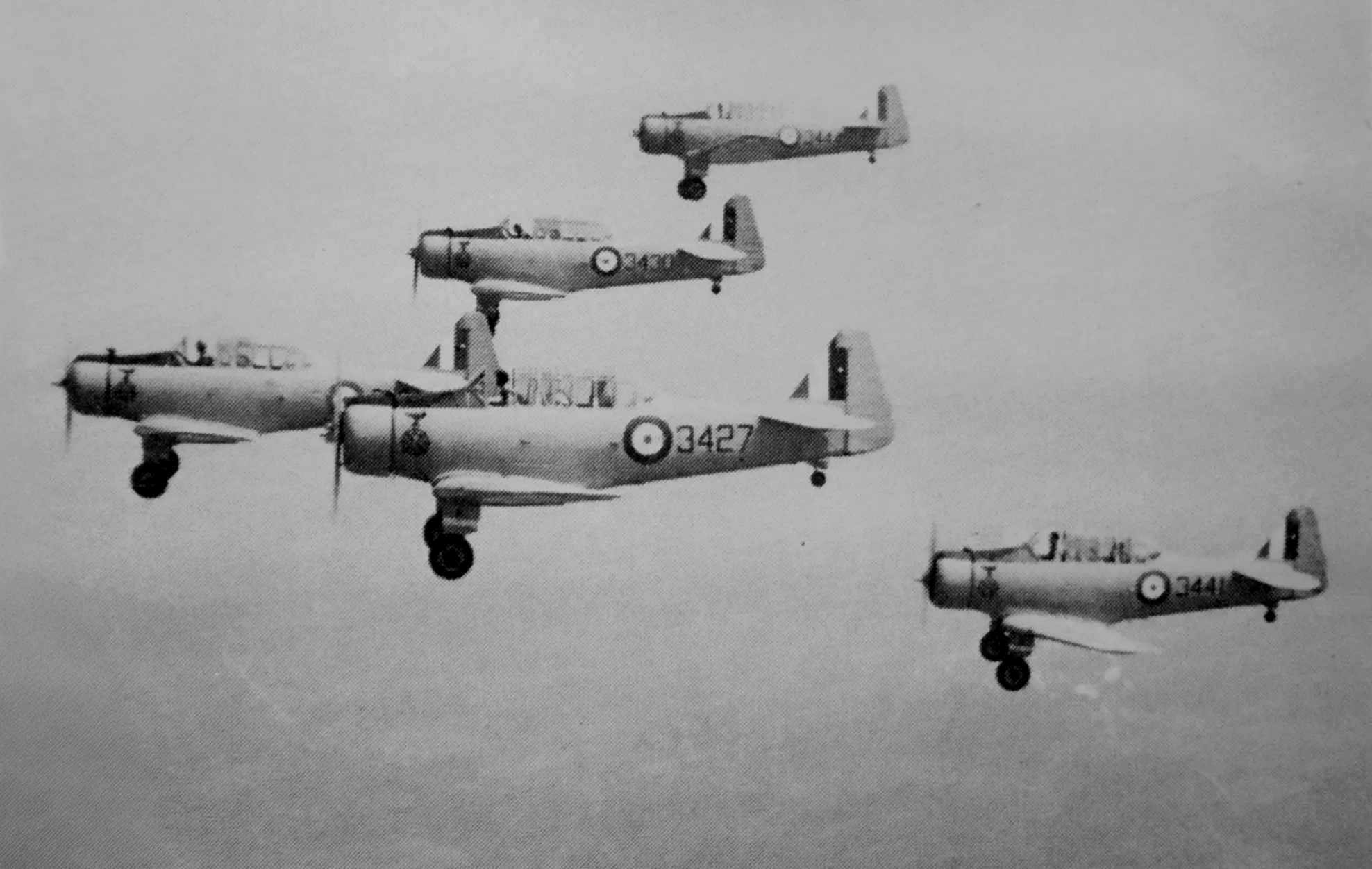
A formation of five North American Yales flying out of Dunnville, Ontario where Tommy was an instructor in 1941. Photo via Lest we Forget by Pierre Lagacé
The life of an instructor who had never flown in combat and was drafted into instruction duties immediately following his wings ceremony, was tedious, repetitive and frustrating for a young man who knew he had outstanding flying skills. For nearly a year he laboured to train others who would then go off to Europe and Asia to do what he so deeply wanted to do himself. It must have been particularly galling when, in November, the station hosted a visit from Battle of Britain ace Group Captain Adolph “Sailor” Malan, one of the best known and admired fighter pilots of the Second World War, there to inspire the young flying students. But he soldiered on and, nearly a year later, on June 30th, when he believed he would be posted overseas or perhaps to a Hurricane OTU in Canada, he was sent back to Trenton’s No. 1 Flying Instructor’s School for a medical assessment.
Even instructors get the blues.
According to a medical examiner there, he was clearly exhausted following the high tempo of instruction at Dunnville. The Trenton medical examiner stated “This officer has been flying as instructor about 1000 hrs. in the past year. Convalescent leave is recommended by the CFI. No weight loss. Sleeping well.” To put 1,000 hours of instruction in just 11 months is staggering. A modern airline pilot typically flies 700 to 900 hours a year, most of that drilling a hole in the sky. To be doing “circuits and bumps” and aerobatics for 1,000 hours is just mind boggling. He was classified as ATBT (Air/Active Temporary, Both Types)—temporarily unfit for any form of duty (air or ground) and was sent to No. 1 Convalescent Hospital. This facility was in fact a large family summer estate on Lake Muskoka, named “Marmilwood” and loaned to the RCAF by the Wartime Convalescent Home War Charity Fund initiated by Francis and Edith Farwell, whose family loaned the property. Edith's son, John Farwell, served as an RCAF Flight Lieutenant.
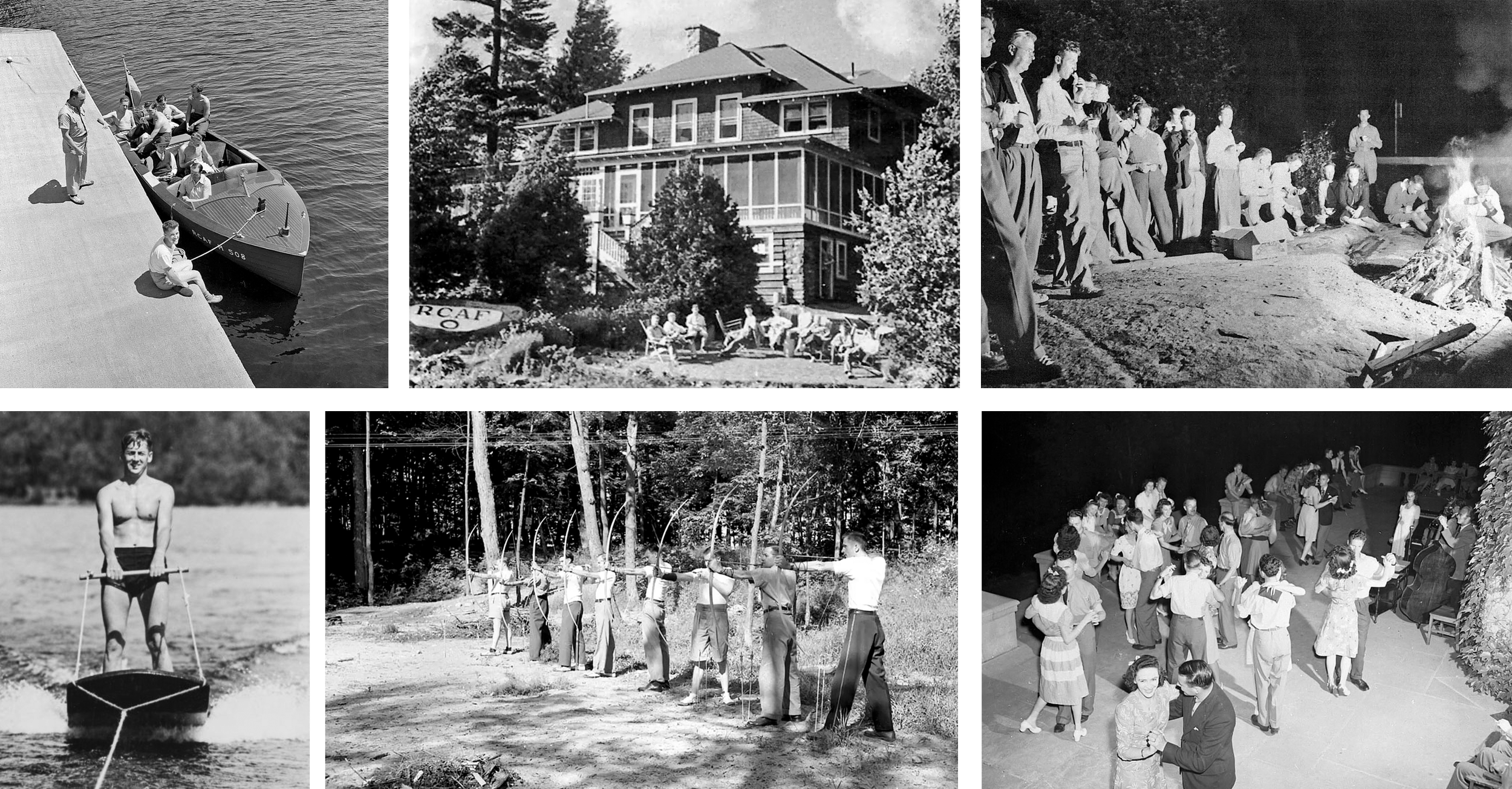
Any Canadian cottager today can speak to the recuperative benefits a week at the cottage can do for you—dancing under the stars, singing round the campfire and ripping around the lake on skis or a wakeboard. The Marmilwood cottage was expanded to accommodate 100 airmen suffering from the stresses of high tempo operations on the Homefront.
Despite the obvious strain the last year had on him, young Tommy Dubroy spent only a week there, water-skiing, playing cards, swimming and doing what we all love to do at our cottages—relaxing. His hopes of operational flying were once again dashed when was posted to another service flying training school—No. 2 SFTS Uplands in Ottawa. It was going to be a long dreary winter ahead. The one positive was that he would be very close to his family for weekend visits and holidays.
It’s a tribute to Dubroy’s instructional techniques that he never shows up on the unit’s Operations Record Books (ORBs) during the entire year that he was at Uplands. Scouring the ORBs, I found no instance of his name listed in connection with any of the hundred or so accidents recorded. Every accident, no matter how minor (from ground loops and taxiing collisions to wheels-up forced landings to fatal crashes into terrain), was recorded with the pilot’s name and service number. If there was both a student and an instructor in the cockpit, the instructor was also identified. Tommy Dubroy had a clean record in that regard. He also received a glowing review of his leadership abilities six months before his posting was over. His immediate commander in No. 1 Squadron at No. 2 SSFT, Flight Lieutenant A. D. Haylett, called him “a flight commander of exceptional ability. An outstanding organizer and strict disciplinarian who has always produced good results. His promotion to acting Flight Lieutenant is highly recommended.”
During his time there, the base was visited by two more high profile fighter pilots: Canadian aces Flying Officer George “Buzz” Beurling DSO, DFC, DFM & Bar of Malta fame and night-fighter ace Flying Officer Robert “Moose” Fumerton, DFC. Once again, the heroic deeds of others must have convinced him his flying ability was wasted on instruction. In addition to visits from Canada’s aces, the location of Uplands in the nation’s capital made for many visiting diplomats, military leaders, politicians and minor celebrities. Among the VIPs touring about the base and addressing or entertaining the officers were Queen Wilhelmina of the Netherlands; King Peter of Yugoslavia; Billy Bishop; Jack Benny and Rochester; Edouard Benes, Premier of Czechoslovakia; Herbert Lehman, Governor of New York (whose son was a student at the school) and George Cambridge, the 1st Earl of Athlone, Governor General of Canada.
Finally, operational training!
Tommy Dubroy suffered through another year of mind-numbing training until, on June 24th, he was posted to 36 OTU Greenwood to train on Mosquitos. He arrived there on the 25th along with 11 other pilots and the 12 navigators of Mosquito Course No. 1. The course commenced on July 5th, 1943. It wasn't a Spitfire, but in many ways, it was even more exciting. The de Havilland Mosquito fighter-bomber was employed in many high-risk and exciting roles as a fighter-bomber, low-level interdictor, clandestine aircraft platform, night-fighter and pathfinder. Any one of these activities was better than his past two years in the Air Force.
It was at Greenwood that Tommy was paired up with his navigator, Flying Officer Fred Haynes, an RAF officer. Dubroy and Haynes spent two months training on the Mosquito for long-distance over-water and over-land operations, graduating on August 8th, whereupon they were granted two weeks of pre-embarkation leave, the last leave they would ever take. For Haynes, who was from England, there was no chance to visit family. With only a couple of days’ travel needed, Dubroy took the train home to Ottawa to visit family and friends.
I can just imagine that last day in Ottawa with his family. After an all-too-short visit, the family walks with him the short distance to Elgin Street and north, past the sprawling wartime headquarters of National Defence to Confederation Square, where just four years before, King George VI and Queen Elizabeth had dedicated the new National War Memorial. As they turn right towards the high, colonnaded entrance to Union Station, they can’t help but feel the power of that monument to sacrifice and loss in the Great War and fear what was in store for their son Tommy after the loss of his little brother Billy the previous year while on operations with Bomber Command. The forecourt of the station’s east door on Sussex Street is bustling with men and women in uniform—some on military business, officers in foreign uniform, recruits with travel chits in hand and some newly-minted aircrew with worried families to see them off. There are shouts for cabs and whistles from the Red Caps, and the rumble of luggage trolleys. Inside, sunlight angles through the smoky blue haze from massive arched windows high above the vast concourse. His mother stops to buy him a sandwich and the morning’s Ottawa Journal at a newsstand. The great hall echoes with the deep voice of the station announcer calmly calling boardings and arrivals on the Tannoy. “Now boarding on Platform 4, CNR passenger service to Montreal with stops at Vars, Limoges, Greenfield, Alexandria, Glen Robertson, Hawkesbury, Grenville, St. Andrews East, St. Benoit and Fresniere.” In Montreal, it was his plan to transfer to The Scotian, the CNR overnight train to Halifax.
Far off in the gloom of the platform shed, the massive 4-8-4 Northern locomotive of the daily CNR passenger train for Montreal, gleaming in black and olive, vents steam impatiently. Platform attendants begin pushing back the high, rattling Bostwick gates. Tommy nervously double checks his ticket. There are hugs and promises to write. His mother dabs her eyes with a white handkerchief. His father olds tight to Annie. Dubroy shoulders his duffle and picks up his Gladstone. The family stands silently as Tommy enters the train shed and walks confidently down the line of deep olive-painted CNR carriages, swirling through rising clouds of steam. Far down the platform he drops his duffle next to his car and, backlit by the dim light of the distant opening, turns to wave goodbye. That will be the last sight of Tommy they would ever see. An image to haunt them in the decades to come.
Into the fight
Tommy Dubroy boarded a troopship on October 8 in New York City, bound for Great Britain. Eight days later, he landed safely on the coast of England (likely Liverpool) and proceeded to the RCAF’s No. 3 Personnel Reception Centre in Bournemouth. It was to be a brief stay at the beachside resort for he was posted to No. 60 OTU at RAF High Ercall in landlocked Shropshire just nine days later. No. 60 was a Mosquito OTU where he and Haynes refreshed their Mosquito skills and honed their craft. For two weeks in November and December he was detached to RAF Chedworth on Gloucestershire to take an air-to-ground gunnery course, something he would need on Intruder operations over Europe. Following 60 OTU, he was posted to 411 Squadron, RCAF arriving there on December 17. For the next few weeks, he bounced around like a pinball with brief moves to 400 Squadron (a mustang photo recce squadron), then 128 Squadron (a Mosquito unit and part of the Light Night Striking Force) then to back to 400 Squadron. These were all likely courses that he was required to attend. All the while he was nominally on the roles of 418 Squadron.
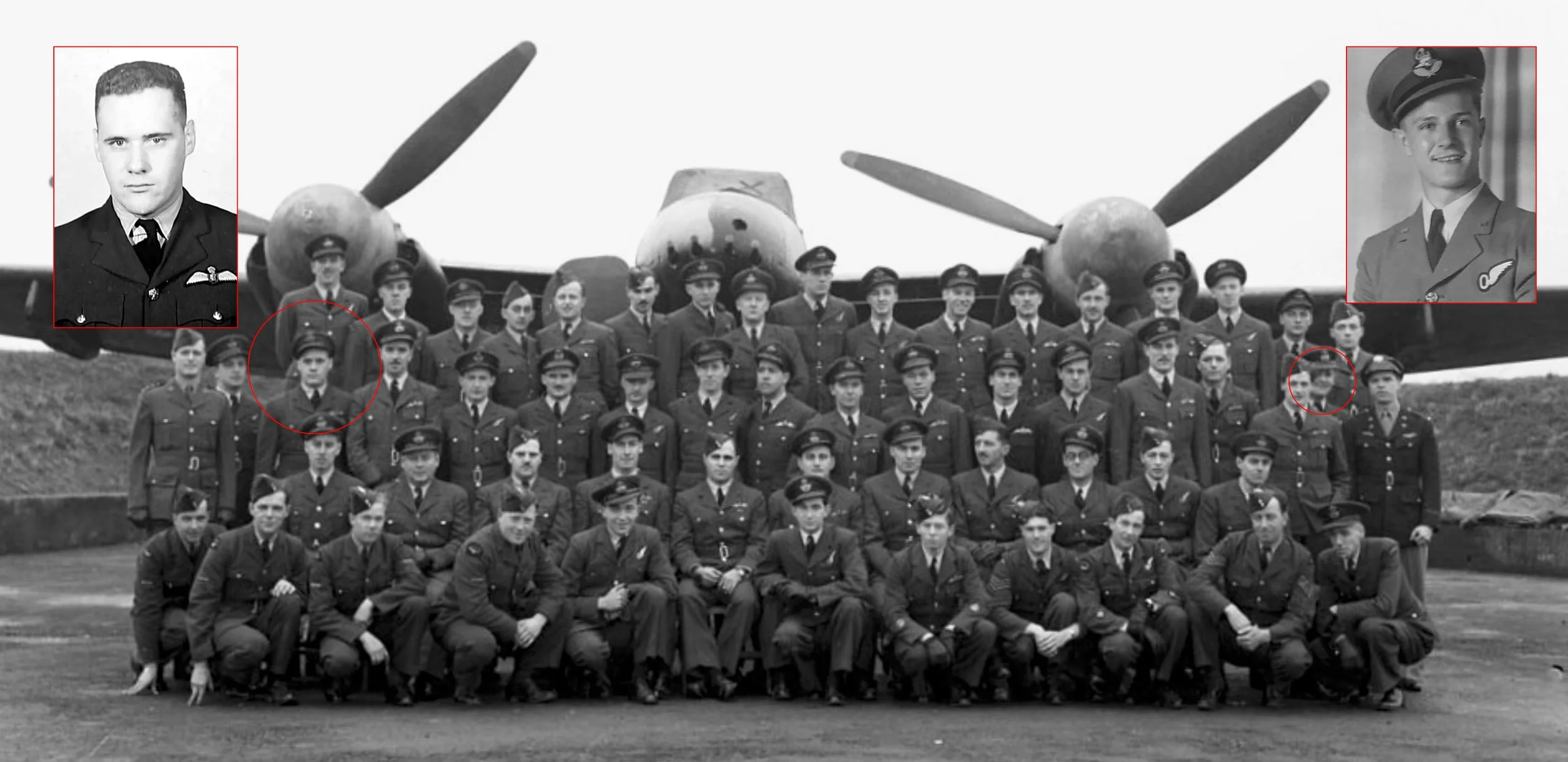
A group photograph (found on eBay) of 418 Squadron pilots, navigators and a few maintainers taken some time around Dubroy’s and Haynes’ time there. The photo accompanied a medal grouping of Haynes’ decorations and personal photos found for sale on eBay by my dear friend Richard Allnutt. It seems very likely that Haynes and Dubroy are in the photo is it was part of the family’s collection. If he is in this shot, I don’t know him well enough to pick him out with certainty. The only airman who seems to look like Dubroy is circled at left along with Dubroy’s portrait for comparison. The only possibility for Haynes in my opinion is the man circled at right and that is based only on a smile and a square jaw similar to that of the young navigator’s. Because of their close relationship since training, one would think that they would be side by side or at least adjacent. The only two I can identify easily and with certainty are the squadron commander, Wing Commander Paul Daoud, (centre bottom) and 1st Lieutenant J. F. Luma, USAAF (far right standing next to the circled fellow). Luma was the only US Army pilot on the squadron and wears his army uniform. He was not the only American on squadron however. Flying Officer Clarence Murl “Jas” Jasper was there as well, but in an RCAF uniform. Photo: Via Richard Mallory Allnutt.
On January 4th, 1944, a relatively clear night, Dubroy and Haynes completed their first operational sortie, a training flight from their base in RAF Ford to Orléans in the Loire Valley south of Paris, selected for its lighter defences. It was an uneventful flight, but Tommy was perhaps not exactly blooded, but at least now fully in the war.
The following night, they attended a performance of “Blackouts of 1943” in the station theatre. The show was a highly successful Second World War musical revue created by the RCAF. Organized in early 1943 at RCAF Station Rockliffe’s in Ottawa, the performance troupe consisted of roughly 35 service members—including singers, instrumentalists, dancers, and comedians—who traveled thousands of miles to boost wartime morale across Canada and in Great Britain. From 1943, they toured Great Britain and post-war continental Europe (including Belgium, Holland, France, and Germany), performing for Canadian, British, and American Allied troops until they disbanded in September. 1945. The squadron diary states that Pilot Officer Brown, the man tasked with organizing and assisting the troupe at Ford, ”received his reward by being surrounded by, generally fondled by and lifted onto the shoulders of the seven beautiful girls who comprise the Sultan’s haram.”
Later that same night, Dubroy and Haynes took off at 6:30 PM for an Intruder patrol from Clermont-Ferrand to Avord and Bourges, again in the Loire Valley. Clermont-Ferrand was—and still is—the global headquarters of Michelin. Under German occupation, the massive plant was forced to manufacture tires to supply Nazi Panzer divisions and the German war machine. Bourges was home to former French SNCAC aircraft factory located at the north end of Bourges Airfield. Following occupation, It was put under the control of the German company Siebel Flugzeugwerke, which used the facility to manufacture the Siebel Si 204, a twin-engine light transport and liaison aircraft used heavily by the Luftwaffe. Bourges sat just miles from the Avord Airfield (Base Aérienne 702), another massive Luftwaffe installation that the Allies frequently targeted in tandem during their pre-invasion bombing campaigns. They reported no activity at any of the targets and light flak. They were home at RAF Ford by 11:30 that night.
Over a week later, on the night of January 14/15, Dubroy and Haynes took off from Ford at 6:50 PM on a “Flower” operation. The primary goal of a “Flower” op was to catch German night-fighters at their absolute most vulnerable moments—either flying straight and level at low speeds during takeoff or while trapped in the landing pattern. At these times, the German aircraft lacked the altitude and speed to execute evasive action. By actively patrolling ahead of the main RAF Bomber Command streams, "Flower" ops were meant to disrupt the German air defense network, keeping enemy fighters away from the main British bombing raids.
That night, RAF Bomber Command sent nearly 500 Lancasters on a night raid to Brunswick (Braunschweig) and Dubroy’s and Haynes’ target was Rheine, Germany (home to a large day- and night-fighter base) and Hopsten airfield just a few kilometres away. These two night-fighter airfields were smack-dab on the bomber stream’s route into their target. Here, again, the ORB is not very detailed. The only information it gives if that the weather was generally very bad for all of 418’s sorties that night including very poor visibility and that Dubroy and Haynes found the airfields lit but empty. They were likely empty because those fighters were already in the air attacking the Lancasters, many of which had taken off around an hour before they had. It was a terrible night for Bomber Command with the loss of 38 aircraft in the raid, 23 of which were shot down by night fighters.
The only flak they reported was from the usual coastal defences as they crossed the Dutch coast at IJmuiden at the mouth of the Noordzeekanaal leading to Amsterdam. They then crossed the North Sea and made their way southeast to RAF Ford in West Sussex without further trouble. They landed back home just before 11:30.
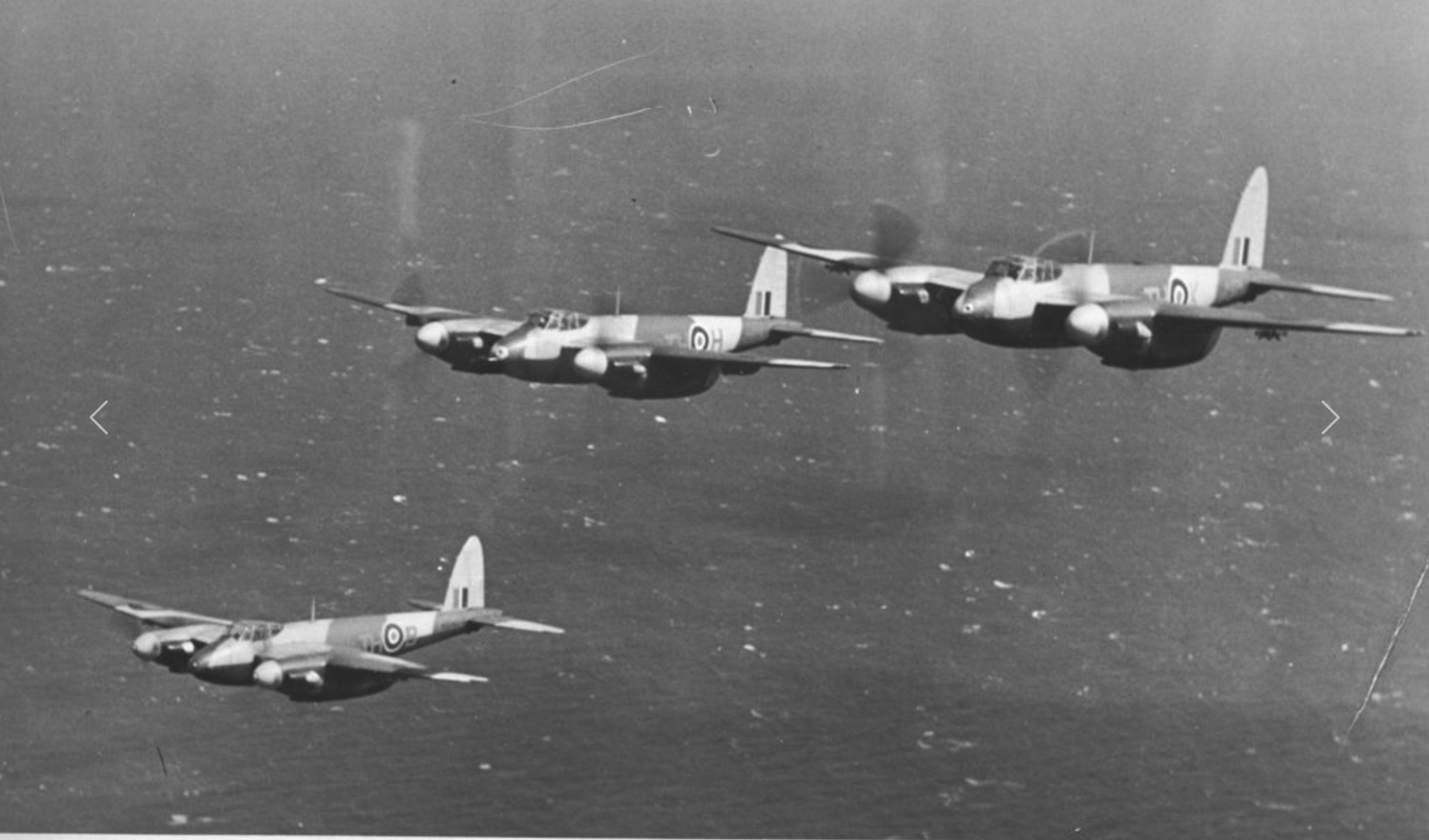
Mosquito intruders of 418 Squadron thunder across the North Sea. 418 “City of Edmonton” Squadron was the most successful Mosquito night-fighter and intruder unit of the war. It is credited with destroying 178 enemy aircraft (with over 105 in air-to-air combat), 9 probables, and 103 damaged. As well, they destroyed 79 to 83 V-1 "doodlebug" flying bombs during anti-V-1 patrols, knocked out 17 locomotives, dozens of rail cars, and over 200 motor vehicles. Crews of 418 flew 3,492 operational sorties and 11,248 operational hours, suffering the loss of 59 aircraft.
It was a full squadron effort at the end of the month when 11 Mosquito VIs of 418 Squadron fanned out across northwestern continental Europe on the night of January 28/29. It was a spectacular show of mission planning as every crew went to a completely different target area, in three different countries, and on three different types of op profiles. There were two first-op training flights to Rambouillet, south of Paris, an area housing vital telecommunications nodes and military staff infrastructure used to coordinate German troop movements and logistics. There were three Intruder Ops penetrating only as far as Lille’s airfield and railway hub, Cambrai’s railyards and the airfield at Beauvais-Tille, all in northwestern France. Aside from hunting enemy aircraft on the ground, these Intruder runs frequently strafed airfields, bombed runways, and used leftover ammunition to attack opportunistic targets like train networks and communication lines to cause chaos.
Bomber Command was staging a massive 677-aircraft raid on Berlin this night and “Flower” ops were the favoured mission profiles used in support of the attack. 418 squadron crews flew eight of them, as deep as Wunsdorf’s night-fighter bases south of Berlin and to Stendal in the north, a core sector for Luftwaffe night-fighter squadrons defending the airspace over Berlin and central Germany. Just the week before, an American 418 Squadron pilot named 1st Lt. James "Lou" Luma intercepted and shot down a German Messerschmitt Me 410 Hornisse (Hornet) heavy night-fighter near Wunsdorf after it had refueled and re-armed from attacking a British bomber. All along the route that Bomber Command flew that night, 418’s Mosquitos were sent in to suppress night fighters. To Laon, in the Hautes-de-France region in the east where the Luftwaffe operated three night-fighter airfields at Couvron, Athies, and Juvincourt. To St. Trond, Belgium where Nachtjagdgeschwader 1 (NJG 1), the Luftwaffe’s most successful night-fighter wing seemed to operate with impunity. To central a south-central Germany: Paderborn and Kassel in central Germany and Biblis farther south where more Me 410 Hornets were based.
The farthest north was the mission straw that Dubroy and Haynes drew—to Vechta. Fliegerhorst Vechta—code-named Schwebebahn (meaning S-Bahn or suspension railway) by the Germans—in Lower Saxony, served primarily as a night-fighter base (Nachtjagd), defending northwestern Germany against Allied bomber raids. Both men listened to the intelligence officer and the meteorologist to learn as much as they could about their target. The crews were looking for a good showing this night, for they were visited in the ops room that evening by none other than Air Marshall Lloyd Breadner, CB, DSC, commander of the RCAF overseas and one of the most important figures in the Royal Canadian Air Force prior to and throughout the Second World War. Coincidentally, Breadner lived on Cartier Street as well… in a much larger house up the street. His only son, a pilot on the RCAF, would be killed a few months later while training at a Mosquito OTU in Nova Scotia. Breadner was accompanied by several RCAF top brass officers including Air Vice Marshall Norman Anderson, Air Officer Commanding for Eastern Air Command; Group Captain G. G. Truscott, Director of Air Staff at RCAF Overseas Headquarters; Group Captain George Graham Morrow, an HQ staff officer; as well as Wing Commander Paul Yettvart Davoud, DSO, DFC, the previous 418 squadron commander and high ranking night fighter ace. Also in attendance was Wing Commander Michael “Mike” Hugh Constable-Maxwell DSO, DFC, commander of 604 Squadron, another Mosquito unit.
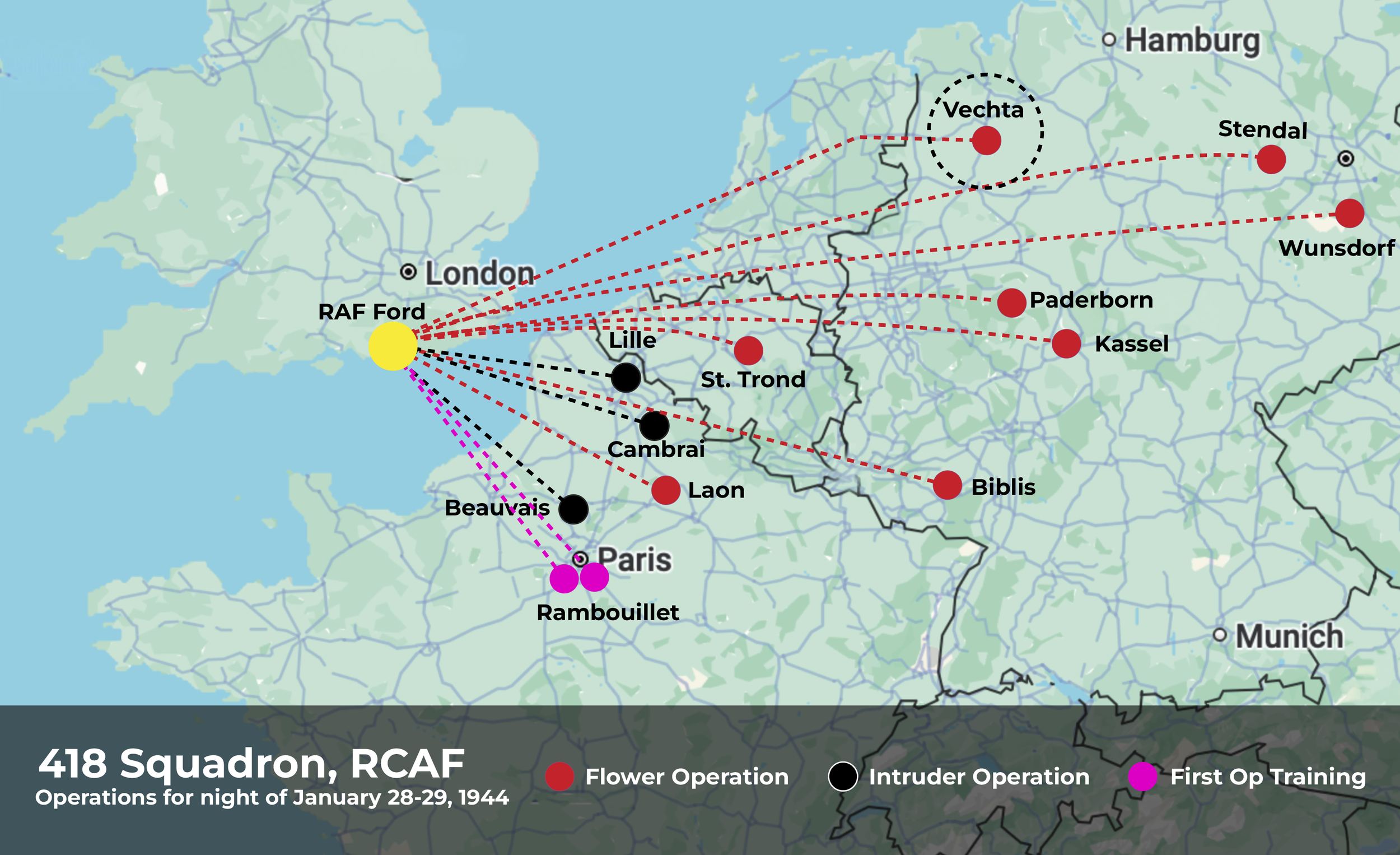
When one looks at the target map for any bomber raid in Bomber Command, there is but one target. There are multiple stations from which each participating squadron launches from, but they all converge near the English coast into the Bomber Stream and head toward a single target in a single miles-long stream. One usually thinks of the squadron arriving together over the target in a loose gaggle or long parade, invisible to each other in the dark. I was truly amazed how eleven 418 squadron aircraft could be sent to this many targets at the same time. As close as 170 miles in the case of Lille and as far as 620 miles in the case of Wunsdorf. One can only imagine the 11 individual met and target briefings the op planners were required to conduct for 418 Squadron that night. Map: Dave O’Malley
Later that night, an hour before midnight, the two men walked out to their Mosquito, HJ722, squadron coded TH-E, sitting dark and menacing out under heavy black cloud and the beginnings of ground fog. After three sorties over occupied France and Germany, they likely approached their aircraft with an increased comfort with their own abilities to get the job done, but their is no doubt they understood the risks of flying deep into Nazi Germany to an airfield where aircraft designed to hunt them down were stationed. German night-fighter units (such as Nachtjagdgeschwader) had no real solution to counter “Flower” ops, but attempted to alter timing, use decoy signals, and scramble or land from alternate, dispersed satellite airfields to avoid waiting Mosquitos. These “Flowers” created significant stress for Luftwaffe crews, a phenomenon referred to as "Moskitoschreck" (Mosquito terror). The Luftwaffe also increased anti-aircraft defences, and one had to consider the possibility that one night fighter would be left to deal with the inevitable Mosquitos. One thing for sure, the Germans knew they were coming.
Shortly after 11:00, they turned their Mosquito onto the active runway, Ahead, they saw the blue exhaust flames of Flying Officer Clarence Murl “Jas” Jasper’s Mosquito climbing out into the black void. No doubt when Dubroy heard that Jas, an American, was from Ottawa, Kansas he had a chuckle. Jasper would go on to be a Mosquito ace with five confirmed aerial victories, three destroyed on the ground and three V-1 buzz-bombs destroyed. Behind Dubroy was the Mosquito of Flight Lieutenant G.L. Thompson and navigator Flying Officer W. A. R. “Red” Stewart who was not flying tonight with his normal pilot Charlie Scherf.
At 11:07 Tommy pushed the throttles up and accelerated down the runway and climbed up into the night. Haynes gave him a heading for their target and they turned northeast, low across a blacked-out Sussex and Kent, heading for the North Se, and the Dutch coast to the north. The next time anyone on the ground saw them, they were on fire and coming in fast over the village of Jakobidrebber.
We will never know for certain if they were shot down by a night-fighter or were hit by flak over Vechta. They crashed more than eight miles south east from Vechta’s airfield, only a minute’s travelling time by Mosquito. My money is on flak taking them down, but it’s impossible to say for sure unless records for night-fighter claims that night near Vechta can prove otherwise.
Despite 418 Squadron’s attempts to disrupt night-fighter attacks on the bomber stream that night, the losses were terrible anyway. RAF Bomber Command lost a total of 46 aircraft in addition to Tommy Dubroy’s—26 Handley Page Halifaxes and 20 Avro Lancasters out of 677 dispatched representing 322 men and a 6.8% loss rate. It likely that most of these losses were due to Luftwaffe night-fighters.
The RCAF wasted no time in informing the family back in Ottawa, that their worst nightmare had just come true. A telegram arrived from RCAF Headquarters telling them that Tommy was missing on operations—the same type of telegram they had received a year and half ago about Billy. Then, they had held out hope for months before he was declared killed on operations. They would do the same for Tommy. Hold out for news of his capture or salvation. Neither would come. A month after Tommy went missing, his father wrote to the RCAF “We feel very hopeful more favourable news will be received and only wish more cheerful news will soon be forthcoming.” Tommy’s parents had now lost two sons to the war, both killed somewhere over Germany.
I can’t help thinking that his mother Annie would, forever, recall to memory the last time she saw him—standing on the platform in the steam and gloom, smiling and waving to her as he slung his duffle, grabbed the rail and hoisted himself onto the CPR train bound for Montreal.
The Dubroy clan had suffered greatly with the losses of Billy and Tommy, but more heartbreak was still to come. Just 10 days later, Tommy and Billy’s cousins on Lebreton Street would suffer a catastrophic loss of their own. One which would take two of that family’s eight brothers in a uniquely tragic training accident in Great Britain.
But, that story is Episode Three of The Dubroy Sacrifice, and coming soon.
Dave O’Malley, October 21, 2026
Appendix
A lot of what I find in researching these stories cannot be used in the stories themselves, but perhaps this following appendix of sorts will help keep that information in daylight for future researchers.
Willian H. “Bill” Armstrong
Lifted from Speed over Time on Facebook
Like many post-war airline entrepreneurs, Bill Armstrong had served in the RAF, flying as a navigator on Beauforts and Beaufighters and rising to squadron leader. A fluent German speaker, he later worked for British intelligence in Germany, where he built contacts that would prove useful in civilian aviation. With Ronnie Myhill, he founded Autair, initially dealing in light aircraft and helicopters. Its early work was varied, ranging from Persil advertising flights for Henkel to crowd-control duties, mountain-survey support, the 1954 German Grand Prix and filming for Hitchcock’s To Catch a Thief.
By the late 1950s, Autair’s helicopter business was sufficiently established to support expansion into fixed-wing operations from Luton, helped by its engineering base and the airport’s improved road links via the new M1. The airline arm, later Autair International Airways, grew rapidly, operating DC-3s, Vickers Vikings, Airspeed Ambassadors and Handley Page Heralds, and benefiting from the expanding inclusive-tour market. It developed a reputation for strong engineering standards and claimed never to have suffered a serious passenger incident.
Autair also benefited from Berlin freight work and was notably early in employing female pilots. Less successfully, Armstrong invested in African aviation ventures, including links with Jack Malloch’s Air Trans Africa, which later became associated with Rhodesian sanctions-busting and arms flights to Biafra. Armstrong would later regard these African investments as costly mistakes. In April 1965, Autair was bought by Court Line, setting it on the path to its later identity as Court Line Aviation.
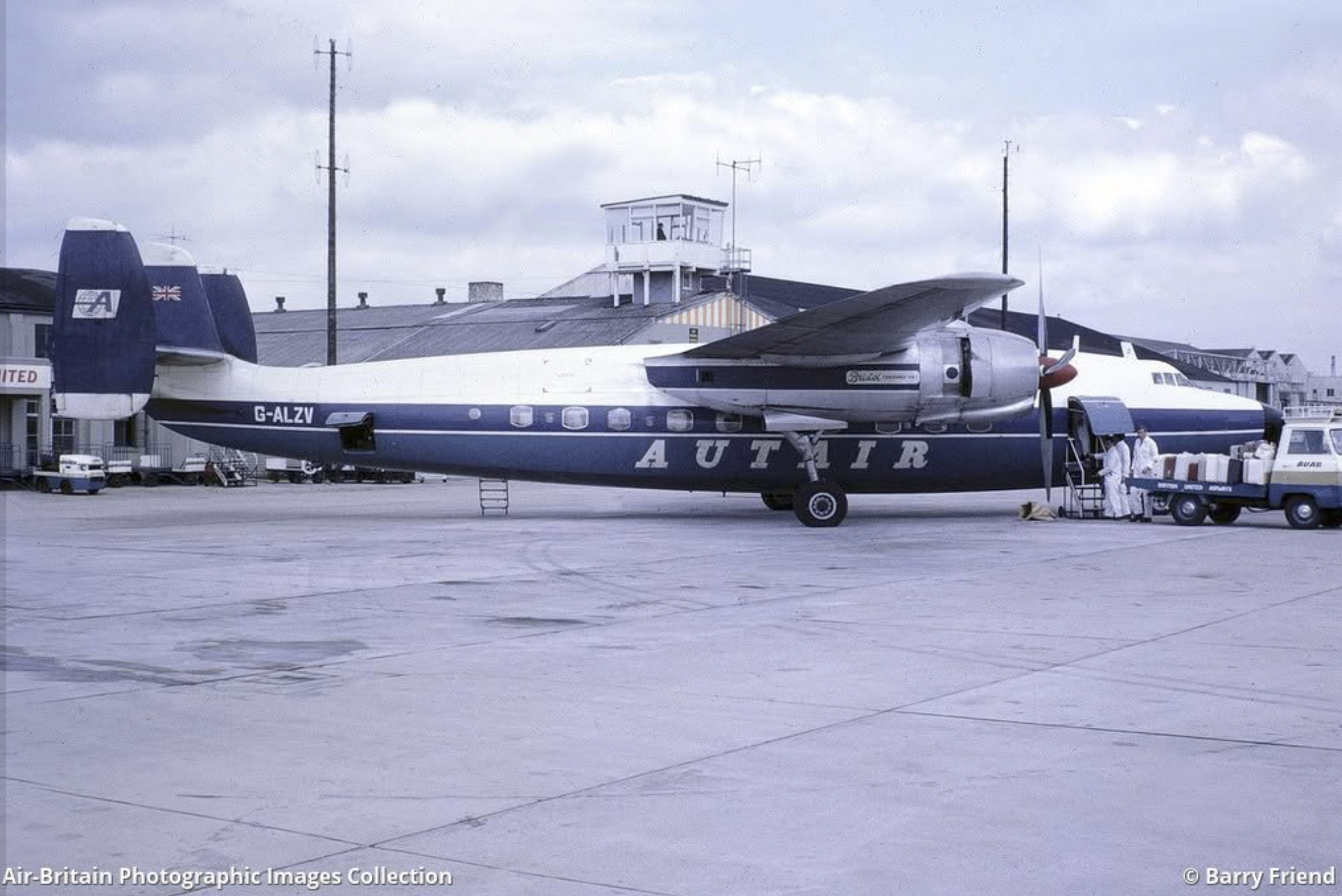
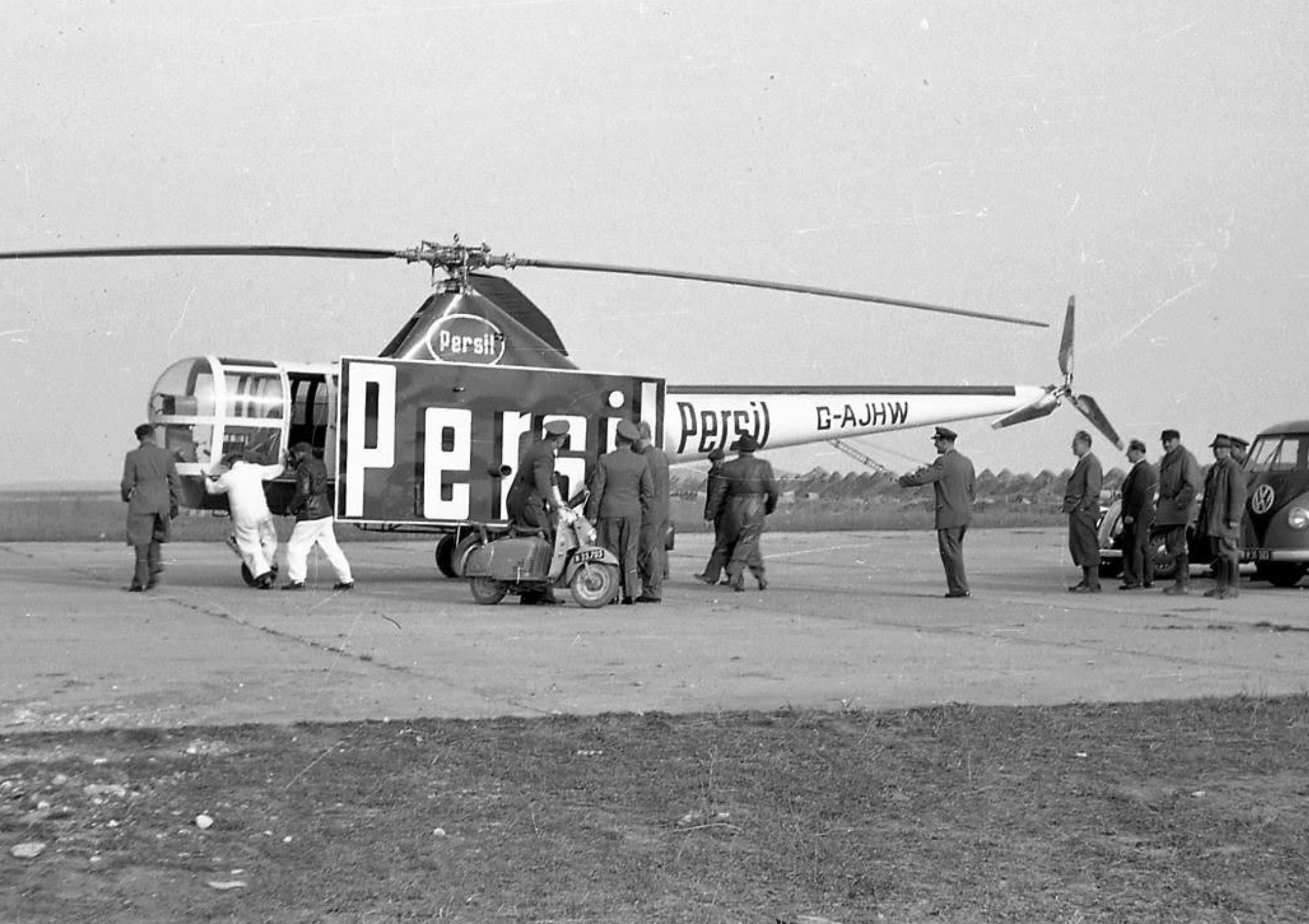
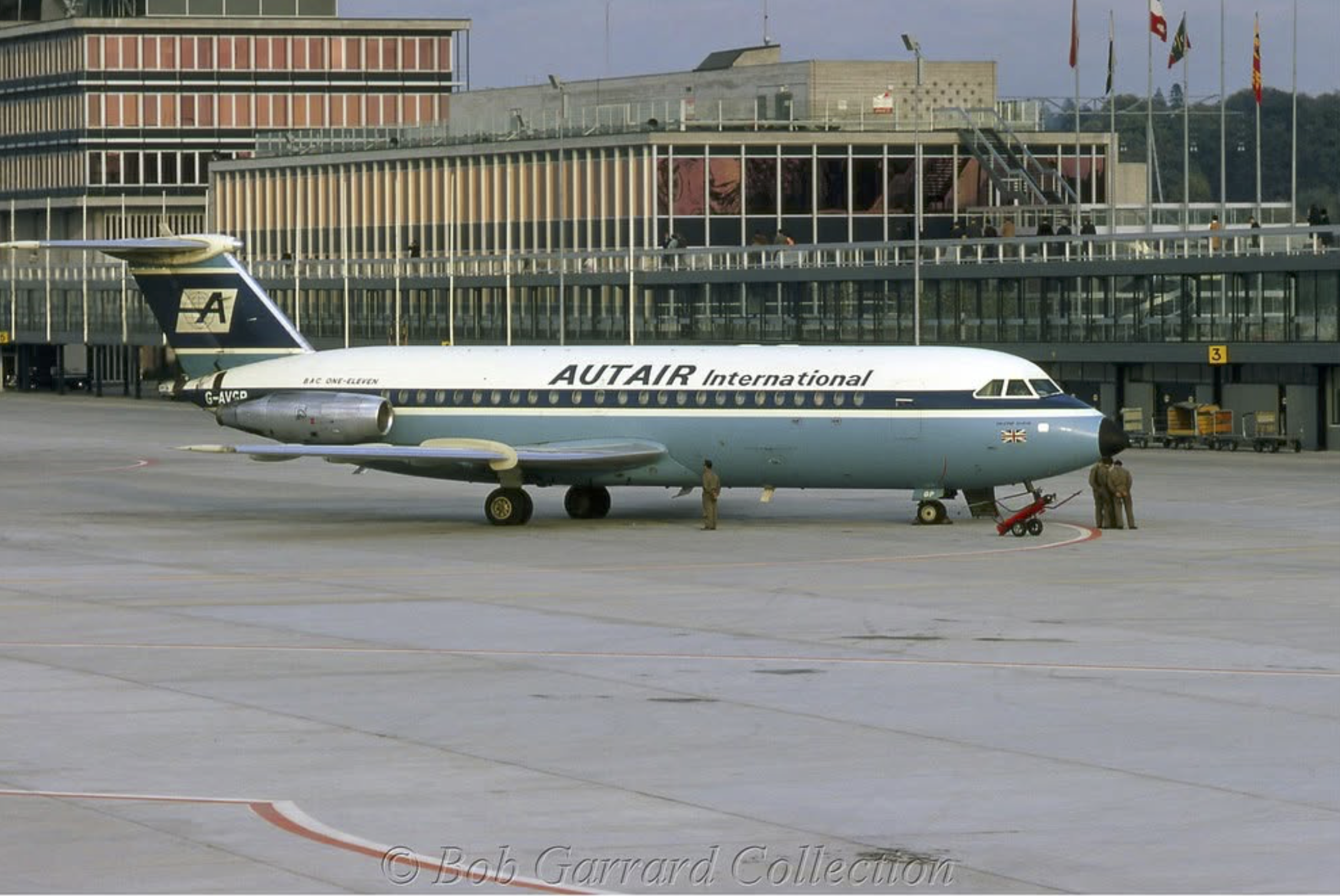
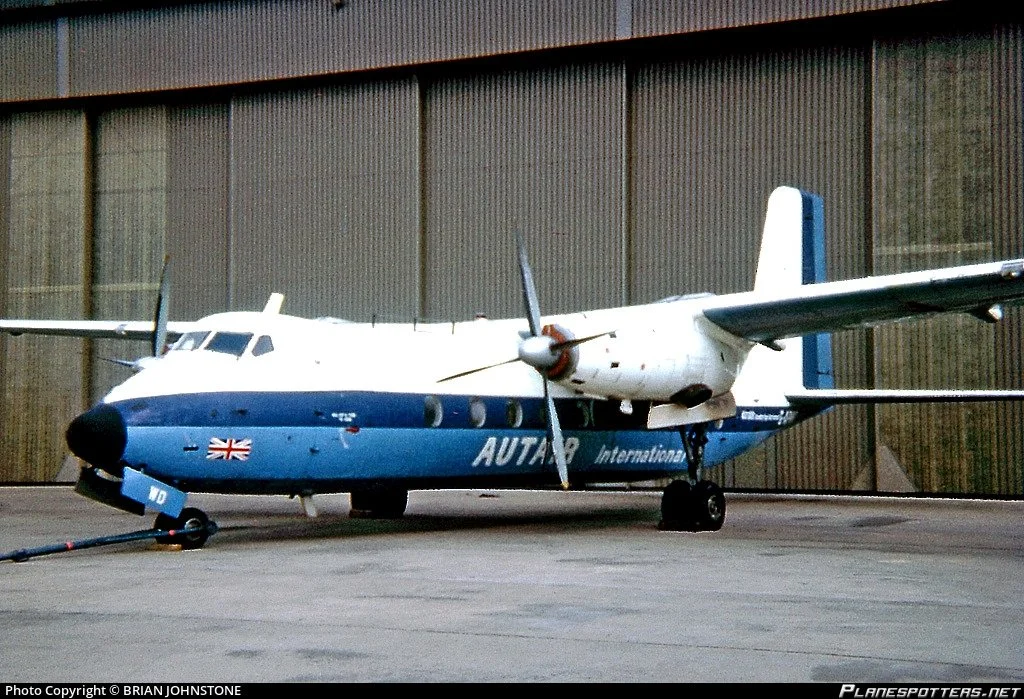
Above photos by (L to R) Barry Friend, AirBritain; Speed over time, FaceBook; Bob Garrard Collection, FaceBook; Brian Johnstone, Planespotters.net
