

The DuBroy Sacrifice – Billy

Illustration: Dave O’Malley
In the Second World War, more than 10,000 Canadian families with sons in Bomber Command received a telegram from RCAF Headquarters informing them that their sons were “missing as the result of air operations” or killed in a flying accident. By war's end, all these families had received at least one more with the final terrible news that, “in view of the lapse of time, there was little hope" of the person being alive and they were “for official purposes presumed dead”. Some families lost two sons, a few lost three. The Dubroy family from Ottawa lost two sets of brothers — Billy and Tommy, of the Cartier Street Dubroys and Eddy and Leonard from Lebreton Street.
Billy was the first to die.
In the afternoon of October 15, 1942 Joseph William “Billy” Dubroy of Ottawa, crushed out his Gold Flake cigarette, blew a last long stream of smoke out the side of his mouth and pushed himself out of the tired brocade armchair in the Sergeants’ Mess at RAF Pocklington. At 21 years, 5’ 6” and just 120 lbs, he was no more than a boy in stature and age, but the two-year struggle to get to this point had left him worn, hard and edgy. A blue tobacco fog tumbled and swirled through the light angling in from the windows. The place smelled of stale cigarettes and pipes, newsprint, spilled beer, burnt toast, Dustbane and paste wax. It was an oddly comforting medley. 10 Squadron’s home base was RAF Melbourne, ten kilometres southwest, but they had been operating so often from Pocklington, it was like home too. Across from him, his British and more experienced crew mates, Freddie Burtonshaw, Allan “Sandy” Sanderson-Miller and C. E. Harrison did the same. The low table between them was piled with worn and folded copies of Picture Post and The Illustrated London News while the last wisps of smoke rose from a filthy Whitbread’s bakelite ashtray. There was a collective drawing in of breath, a slumping of shoulders, a resignation of sorts. There was no talking. The four filed out into the sunlight and fresh Yorkshire air, eyes adjusting to the slanting gold light of late autumn. Their battered green Phillips Military Roadster bicycles leaned against the mess wall, and without a word, they stood them up and pushed off towards the briefing hall to meet the others. The rest of the crew were officers, but Dubroy and his three pals were Sergeants and, though they shared the same risks, they didn’t share the same perks. It bothered some, but Billy was young and easy-going. He didn't think much about that. Just the terror that lay in wait for him.

Sergeant Joseph William “Billy” Dubroy. Photo: Newspapers.com
They were drawn. On one hand they felt lucky to be part of the Winco’s crew, to fly with the most experienced pilot on the base—Wing Commander Richard Kemp “Dicky” Wildey, DFC. Harrison, the wireless operator was as experienced as the skipper, having flown on operations with 10 Squadron for almost two years. Billy tried to emulate his calm bearing and guarded speech, for Harrison represented the very best of something that he had failed to achieve. He had really wanted to be a Wireless Operator/Air Gunner, or WAG as they were called. He knew he didn’t have what it took to be a pilot or navigator, so he put WAG down on his attestation paper as his preference. The reviewing officer had hopes for him too, stating that Billy was “A good type, clean cut, keen-intelligent, calm, very eager to fight and fly—should make a good air gunner.” It was a far more technical and respected skillset on the aircraft, but he failed to achieve his goal. Miserably in fact. Following his time at Manning Depot in Brandon, Manitoba, he was posted to No. 2 Wireless School in Calgary on June 23, 1941, to learn the radio component of a WAG’s duties.
Notwithstanding his and the RCAF’s hopes, he crashed and burned. Despite attending the full course of study and then being given additional tutoring and an extension of two whole months, he took the train out of Calgary on January 22, 1942, bound for Trenton, Ontario with nothing to show for seven months of grinding study. His Air Crew, Ceased Training form was signed by the school’s Commanding Officer who added that he “Failed to graduate due to being below the minimum acceptable standard… Recommended for air gunner after two months general duties.” He was posted to No. 1 Composite Training School (KTS), RCAF Station Trenton, a "reselection centre" and school of administration. KTS was often the destination for personnel who had "washed out" of other aircrew training programs and needed to be reassigned to different roles. Luckily for Billy, after two months he was posted to air gunnery school at Fingal, Ontario on the shores of Lake Erie. Finally, four weeks later on April 15, he was awarded his much-desired aircrew brevet—a single wing attached to a badge featuring the letters AG surrounded by laurel, topped with the King’s Crown of St. Edward with the letters RCAF ringing the bottom. A simple device that finally earned him the respect of his family, his friends and above all, his crew mates
Since he had arrived on squadron Billy had flown as part of the lead crew—not because of his experience, for he had none, but perhaps to give him guidance. On his first “op,” a raid from RAF Pocklington to Saarbrücken’s steel and armaments factories at the beginning of September, he was mid-upper gunner with Wildey’s crew. On October 5th, he joined them again for an attack on Aachen. Tonight, would be his third op with Wildey and for a young man lacking in confidence, he was beginning to feel part of the crew..
On the other hand, October had been tough on the squadron, and the boys were on edge and stressed. At the beginning of the month, the squadron had the blackest night of its existence. Five 10 Squadron Halifax bombers took part in a small raid to the Danish border, sortieing to join 405 Squadron Halifaxes for an attack on the submarine works at Flensburg. Four of the five did not return. 405 Squadron lost four of their eight aircraft that night too, including the famous Halifax (W7710) Ruhr Valley Express, known for its unique nose art depicting a train chasing Luftwaffe leader Hermann Göring, the bomber added a new train car after each mission. Twelve of the 27 participating Halifaxes were lost to flak and night fighters. Eighty-four men were killed or became PoWs. Luckily, Billy wasn’t on the roster that night. After Flensburg, all the crews grew quieter. Drank more gin and beer. Smoked more cigarettes.
At the briefing, they crowded together with the other seven crews in the stuffy darkened briefing hall. The chatter stopped when Wildey stepped onto the rostrum with the met officer, the “trade leaders” for navigation, bombing and radio and the intelligence officer — the men who prepared the battle order. The target was Cologne (Köln) on the Rhine River. Billy had not yet been there, but he had heard others talking about it. About the big 1,000-bomber raid the previous May. The one they called Operation MILLENNIUM. Cologne was an important transportation centre and industrial hub. The raid tonight was part of a series of raids aimed at "area bombing," or targeting the entire city to disrupt the German war effort rather than precision bombing of specific military installations. It was an easy target to hit… if you made it through the defences. Those were formidable.
By October 1942, Cologne was one of the most heavily defended cities in Germany, protected by a sophisticated, layered air defence network designed to counter the RAF's growing bombing capabilities. In the wake of MILLENNIUM, the Luftwaffe reinforced the Reichsverteidigung (Defence of the Reich) to protect this key industrial hub. The intelligence officer made no bones about it. It was going to be a tough “op”. The city was protected by a dense ring of flak batteries, including heavy guns (such as the 88mm, 105mm, and 128mm) and lighter guns for lower altitudes. These batteries were effectively created a murderous "flak box" over the city, forcing bombers to take evasive action, which ruined bombing accuracy. In addition, night fighter squadrons were active in the region, coordinated by ground-based radar stations. These fighters were increasingly successful at finding and shooting down bombers in the dark, often engaging them as they approached or left the heavily defended and illuminated flak box.
The squadron would be contributing eight of its Handley-Page Halifax aircraft this night as part of a 289-bomber raid — a big raid, but not necessarily enough to overwhelm the defences. After the briefing, the crew—pilot Wildey, mid-upper gunner Billy, rear gunner Flight Lieutenant Alfred “Fred” Brindley (a rare high-ranking officer in the gunnery trade), flight engineer Burtonshaw, wireless operator Harrison, bomb aimer Sanderson-Miller, navigator Flight Lieutenant Mike MacFarland Davis and just for this op, a second pilot names of Pilot Officer James Wilfred Murphy, a Canadian from Owen Sound, Ontario. The Halifax usually flew with a crew of seven, but now and then a new pilot would fly along with the crew. Known as the “Second Dickey” (quite appropriate this night as the aircraft commander was Dicky Wildey) a bomber pilot, fresh from the Halifax Heavy Conversion Unit, flew with a much more experienced crew (often the squadron commander’s) to gain realistic experience with the stresses of combat before taking his own crew into harm’s way. It was also a way for the CO to gauge the kind of man he was. It was Murphy’s second “Second Dickey” flight. Two days previously, he had flown with B-Flight Commander, Squadron Leader Debenham. It was no milk run. Debenham’s Halifax, “R for Roger”, was hit by flak over Kiel and the flight engineer Sergeant Wilkinson had been severely wounded in his hands, left shoulder and thigh. It was Murphy who had to staunch the blood and keep him conscious on the long flight home. Tonight, would be another test, one that would change the course of his life. Meanwhile members of his own crew remained on the ground awaiting his second blooding.
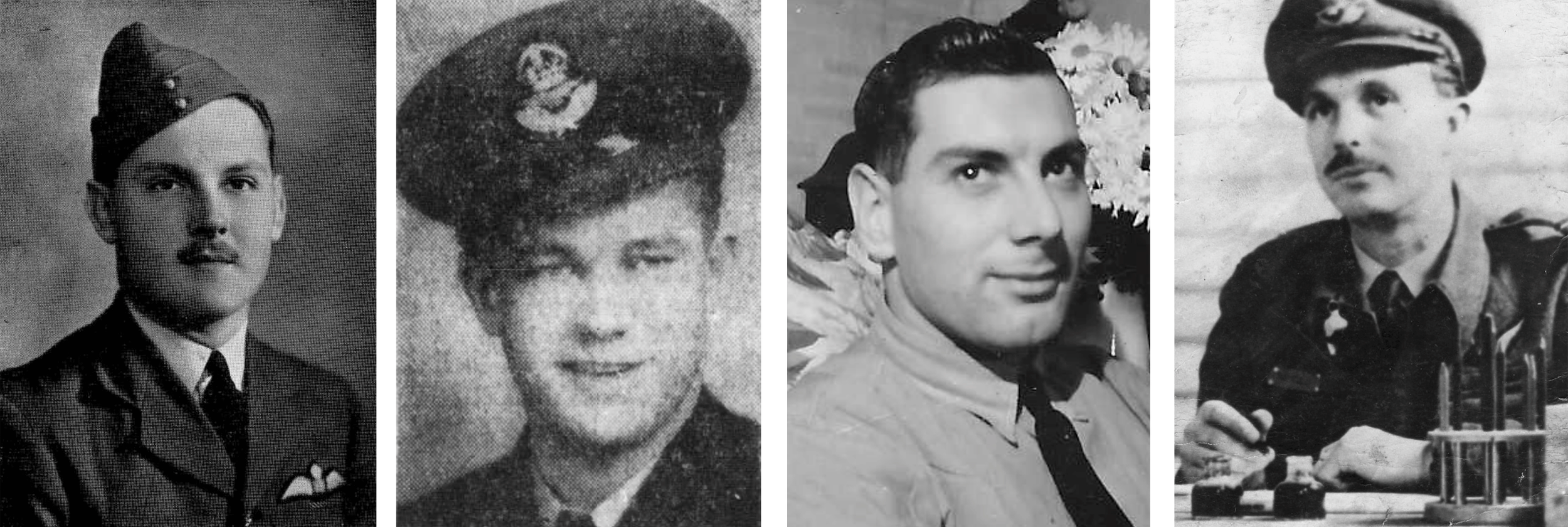
Wing Commander Richard Kemp “Dicky” Wildey, Pilot: Pilot Officer James Murphy, “Second Dickey” Pilot; Sergeant Frederick Esmond Perry Burtonshaw, Flight Engineer; Flight Lieutenant Alfred “Fred” Brindley, Rear Gunner. Photos: findagrave.com, newspapers.com, and ancestry.com
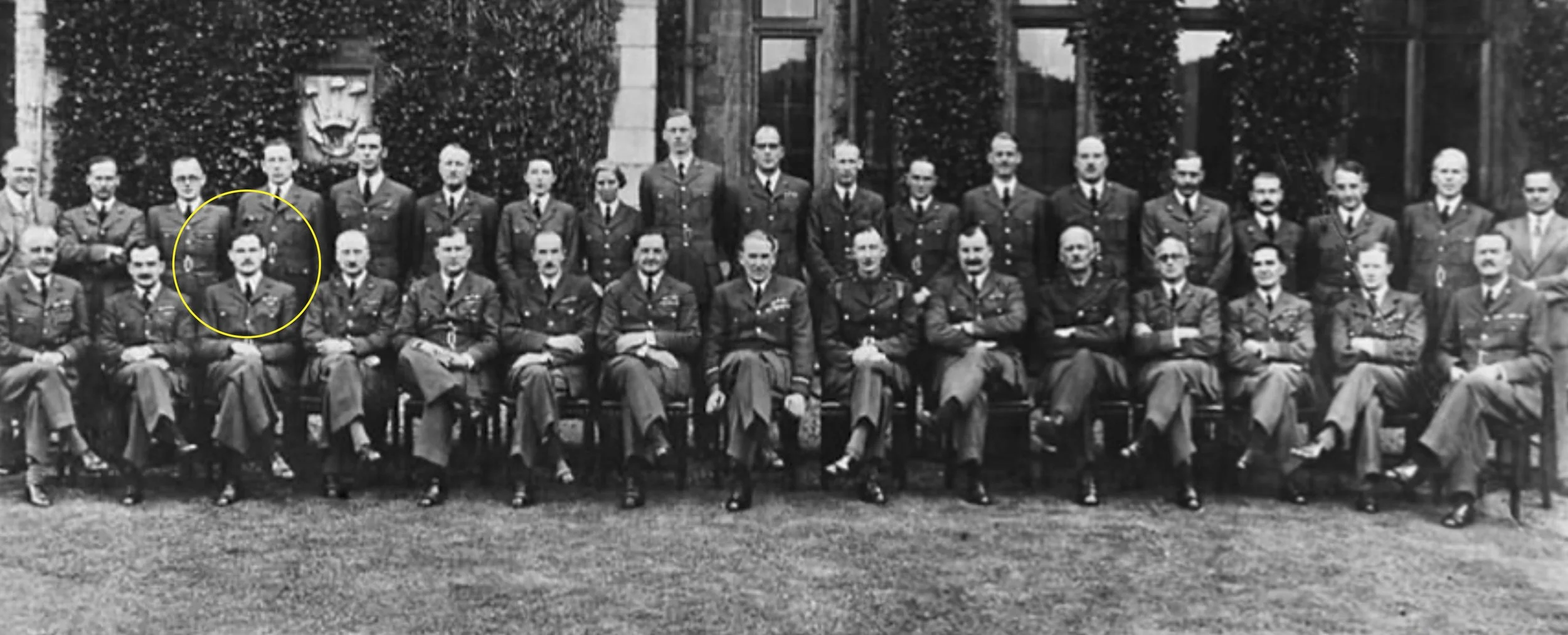
Billy Dubroy couldn’t ask for a more competent and experienced crew leader than Wing Commander Dicky Wildey. Before his command of 10 Squadron, he flew with 51 and 78 Squadrons and then was posted to RAF Bomber Command Headquarters Staff. Dead centre in the front row is Air Vice Marshal A.Coningham, DSO,MC,DFC,AFC, Officer Commanding Bomber Command. Photo: Imperial War Museum
Preparations
Around 5:45 PM, shortly after the sun had set that evening, the crew bus came to a squealing halt in front of a Roll-Royce Merlin-powered Handley Page Halifax four-engined bomber, serial number W1058. On the massive, slabbed flanks of the black-painted bomber were the letters ZA-S, four feet tall and painted in red, denoting first its two-letter squadron code ZA and then its aircraft code — “S for Sugar.” The Halifax loomed large, cold, inanimate and menacing in the Yorkshire dusk.
Each member, except perhaps Murphy, had developed a ritual. Wildey spoke to the ground crew chief, making sure “S for Sugar” was all set to go, then walked to the tail wheel assembly and unloaded the contents of his bladder… to drain the tea away, but also for good luck. Then he pulled out his torch and entered the low crew hatch aft of the wing on the port side, and worked his way forward, dragging his flight bag. “Sandy” Sanderson-Miller spoke quietly to the armourer to make sure they had the correct bomb load — three 1,000 lb General Purpose Bombs, seven S.B.C.s (Small Bomb Containers, each containing 90 4-lb bomblets) and four additional S.B.C.s (each containing eight 30-lb bombs)—a load meant for general destruction. Dubroy crushed another cigarette beneath his flight boot on the dispersal tarmac and, following the more experienced rear gunner, climbed aboard, with his torche in hand. With daylight now all but gone, Fred Brindley shone his torch to the rear, ducked his head, and encumbered by a heavy fleece-lined flying suit over his "teddy-bear" suit, a wool turtleneck sweater, and another electrically heated flying suit, made his way down the dark interior toward his rear turret, ducking beneath the feed channels for his .303 ammunition. The Boulton Paul Type E turret was a spherical contraption designed specifically for the heavy, Browning four-gun machine he used to protect the bomber’s most vulnerable “six o’clock” position. Like Billy, he was a small man, perfect for the claustrophobic and cramped “electro-hydraulic”-powered turret.
Billy was wearing similar gear, because at 20,000 feet the two turret gunners in the unheated part of the aircraft were most exposed to the elements. Temperatures generally drop two degrees for every 1,000 feet of altitude. Up there in October, the outside temperature would be lower than minus 30º Celsius. His was the mid-upper turret, a two-gun Boulton Paul machine — a Perspex pimple set atop the fuselage just aft of the wing root. He checked his gear and the weighty belts of .303 calibre machine gun ammunition which were “servo-fed” from magazines attached to the turret. In all there was 2,400 rounds, enough for a minute of sustained fire. Brindley had a minute’s worth of defensive fire too, but with four guns he needed 4,000 rounds—all servo-fed from central ammunition boxes along two suspended and flexible tracks all the way to the back. Mid-upper gunners (and rear gunners) were required to be in their turrets for take-off and landing to scan the sky, as night fighter attacks could occur shortly after leaving base, even as they lifted off. To squeeze into his turret, it was pre-rotated to a set position, and he entered through a cutaway portion of the turret drum. He had hung his parachute on the fuselage wall, as there was no room inside. If he needed to abandon the aircraft in an emergency, he’d have to rotate the turret to the correct position (if it was still powered), squeeze out, strap on his chute and make his way to the crew door. Once inside, he sat on a padded seat with his legs in the aircraft's fuselage on a footrest which he had lowered, while his upper body and head were inside the transparent dome. He then folded down armrests on either side to support his arms for getter control of the joystick turret controller.
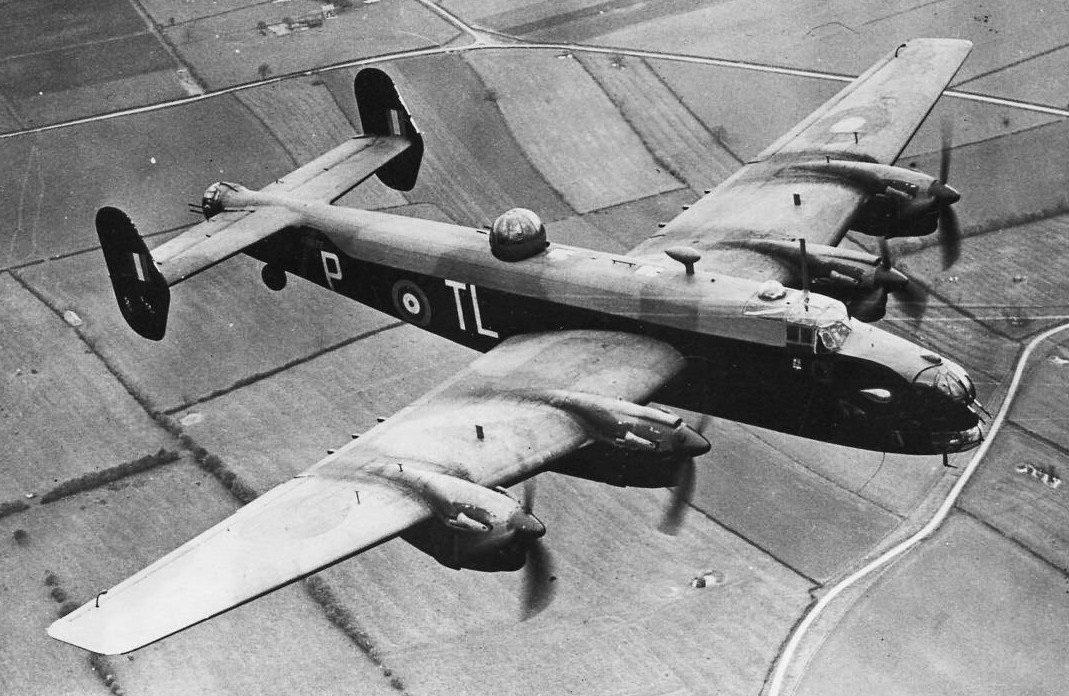
A Handley Page Halifax Mk II in similar configuration to the W1058. Billy Dubroy’s position was in the top turret with an extraordinary 360º view. Photo: Imperial War Museum
Wildey was followed by the others in order of their place in the fuselage, with the furthest forward first. There was much grunting, scraping of boots, clanging of parachute buckles on aluminum, some quiet cursing. Sanderson-Miller, the bomb aimer, who would lay prone in the very nose of the aircraft for the bombing run, came next. He would squeeze in beside Davis on a fold down seat for most of the trip, helping him with fixes and weather reports from the radio operator to assist the navigation process. But at the start he went all the way forward to check the belts of the twin Browning machine guns of his nose turret and stow his gear. There wasn’t much use for the nose turret on a night bombing raid since nearly all attacks by night fighters came from aft. Unlike American “bombardiers”, he didn’t have to carry a wooden box with a super-secret Norden bombsight with him on boarding. His, a Mk. XIV “Blackett” bombsight, was permanently affixed in the nose. The name came from its designer, Nobel physicist Patrick Blackett.
Right behind him came navigator Mike Davis carrying a homing pigeon in a yellow aluminum box. The nervous cooing of the bird added to the surreality of the dark, oppressive world they had entered. He stowed the bird box on a rack next to him and sat down at a narrow map table on the port side of the fuselage facing a small triangular window—pretty well useless on these night ops. Then wireless operator Harrison handed down a second pigeon box which Davis stowed next to the first. If “S for Sugar” was shot down or had to ditch in the North Sea, the crew would release a pigeon with the last known coordinates to alert air-sea rescue, as radio communication could be intercepted or equipment damaged. Harrison then turned sideways and stepped down onto the floor of the forward crew compartment and slid left into a forward-facing compartment with his radios, directly beneath the floor under Wildey’s seat. For these three men, claustrophobia was a constant companion. The beam of the Halifax was not much more than two fleece and leather-covered shoulder widths. Their parachutes hung on the starboard wall. If he was uncertain of the aircraft’s position, he would have to move up to the astro-dome to use his bubble sextant to “shoot the stars”—that is, provided he could see the stars and the horizon.
Second Dickey pilot Jim Murphy came forward next, folding down a jump seat from the starboard wall behind him, then hoisted himself up onto it. Normally the flight engineer sat here to help the pilot start the engines and adjust the throttles on take-off, but tonight Murphy would do those jobs and get his second taste of combat. In earlier Halifax aircraft, a second pilot was standard, but that was soon discontinued as unsustainable. The loss of one aircraft meant to loss of two costly-to-train pilots. Behind him came Burtonshaw, squeezing into a narrow booth behind Wildey facing a mosaic of dials and switches in front and behind him. From here he would monitor pressures, temperatures, fuel flow and transfer and the complex system needed to start and run a Merlin engine… times four. Flight engineers weren’t used on earlier twin-engine aircraft types of Bomber Command—Hampdens, Wellingtons and Whitleys—but in 1941 and ‘42 they were introduced to support the operation of the new, complex four-engine heavy bombers. As aircraft like the Short Stirling, Handley Page Halifax, and Avro Lancaster entered service, the increased technical workload required a dedicated specialist to manage engines, fuel, and systems, creating the standard seven-man crew like Wildey’s. He was essential to quickly extinguish engine fire—closing its fuel lines while increasing RPM on the remaining engines to compensate for its loss and feathering dead propellers while the pilot evaded attack.
Each man made himself as comfortable as he could, plugging himself into the oxygen system and the “interphone”, donning his headset and mic and announcing his readiness to Wildey. Billy and Fred plugged their electrically heated suits in as well. Then began the well-practiced choreography of starting the four Merlin engines and the crew’s world went from muffled grunts, cooing pigeons and scuffing boots to a hell storm of internal combustion. With a metallic, grinding whirr, Billy rotated his turret to face forward to watch the belches of smoke and yellow flame at the start of each engine. He knew his night vision would return before they took off as the flames soon settled down to pale blue blowtorches which barely escaped the glare shields over the exhaust ports.
He watched as an “erk”* ran beneath the fuselage on the port side and came out dragging the heavy steel pipe frame that was used to chock the wheel. The same erk ran under once again and came out the starboard side dragging another chock, stood up, raised his arms and jerked his thumbs outward a couple of times. The men had been tense all day, some thinking about Cologne’s heavy flak defences, some about the Flensburg raid a couple of weeks before. They had worked hard to mask their fears, but now, with the mission ahead and the team working together, the jitters they called “flak happiness” or the “knackers” had been pushed beneath a blanket of competency. For the time being.
* an “erk” is a slang term for the airmen (AC2s and LACs) who were part of the ground crew servicing RAF aircraft. It is said to derive from a shortening of the word aircraftman as spoken with a Cockney accent—“erk-raftman“
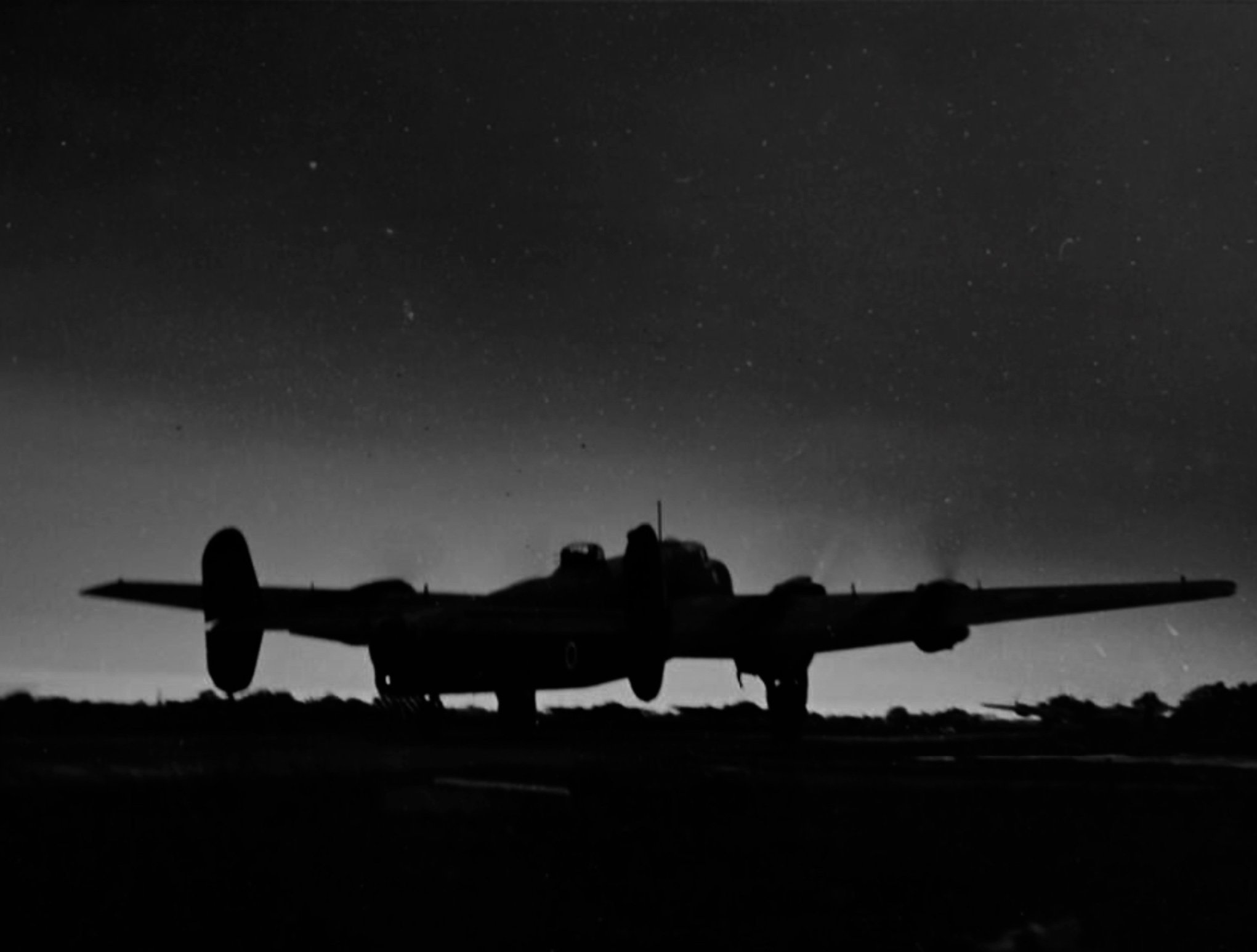
A Halifax of Bomber Command takes off into nightfall en route to a bombing raid deep into Germany. Photo: Imperial War Museum
Only the two gunners, with little to do and fuelled by their isolation from the rest of the crew, continued to deal with their fears. Both began nervously rotating their turrets and elevating their Brownings. Just to do something to keep the knackers at bay. As they trundled along the outer ring taxiway in the dying minutes of the gloaming, Billy’s heart pounded and he took deep breaths, keeping his eyes on the darkening sky. At 6:33 PM, lined up on the runway or RAF Pocklington with the previous day a pale pink remnant on the western horizon, Wildey and Murphy walked the four tall throttle levers up their channels and “S-Sugar” began to move. Slowly at first under the weight of full fuel and bomb loads, but inexorably. Toward their destiny.
Billy felt Wildey push the yoke forward to bring the tail up to flying-off attitude and was instantly more comfortable in his sling. It was going to be a five-and-a-half-hour flight to Cologne and back and he would remain right here for all of it. It could be worse. He could be in Fred’s place. As Wildey lifted the Halifax off the runway, Billy began a random rotation of his turret, scanning the darkening sky filled with stars seen through the clouds. He would keep this rotation and search going for the rest of the flight. That was his only mission.
As Wildey climbed the Halifax out into the depths of the night, Davis gave him a vector due south to the beacon at RAF Cottesmore, where they joined the bomber stream on an easterly heading, outbound for Southwold on the Sussex coast. From there, Davis had him angle off south toward the coastal town of Ouddorp in Holland. This route was chosen to avoid the flak concentrations around Rotterdam and to penetrate Dutch airspace over the waters of the complex estuarial geography of the Oosterschelde thus avoiding as much coastal flak as possible. On crossing the coast, Billy and Fred began an incessant and exhausting panning and elevating of their guns, the turret whirring, buzzing and rattling with every sweep, their pupils open wide, desperately searching for an indistinct shadow, a flash of dull, burnished moonlight, a telltale blue flame in the darkness. As the Halifax pounded through the night sky on the final leg into Cologne, he could see the pale strokes of blue searchlight beams silently probing and sweeping the sky ahead. There were still 15 minutes to go before they got there, but the city was already under attack by the bombers at the head of the bomber stream. The enemy was awake, angry, and desperate.
He felt so deeply alone on the back of the nearly 30-ton bomber. The fuselage top slid away in both directions, blue and barely visible in the weak light of a waxing crescent moon. On either side, the pale dishes of the propellers were almost invisible. Otherworldliness pressed in around him. He felt that he existed outside of time, immersed in a waking nightmare — the coming hell far ahead, the occasional tracer stream silently hosing far off in the distance, perhaps a nervous gunner, the calm voice of Wildey on the interphone, the lurking danger somewhere out there in the blackness. The constant rotation and counter rotation made him feel like a wild animal cornered by and snapping at unseen wolves.
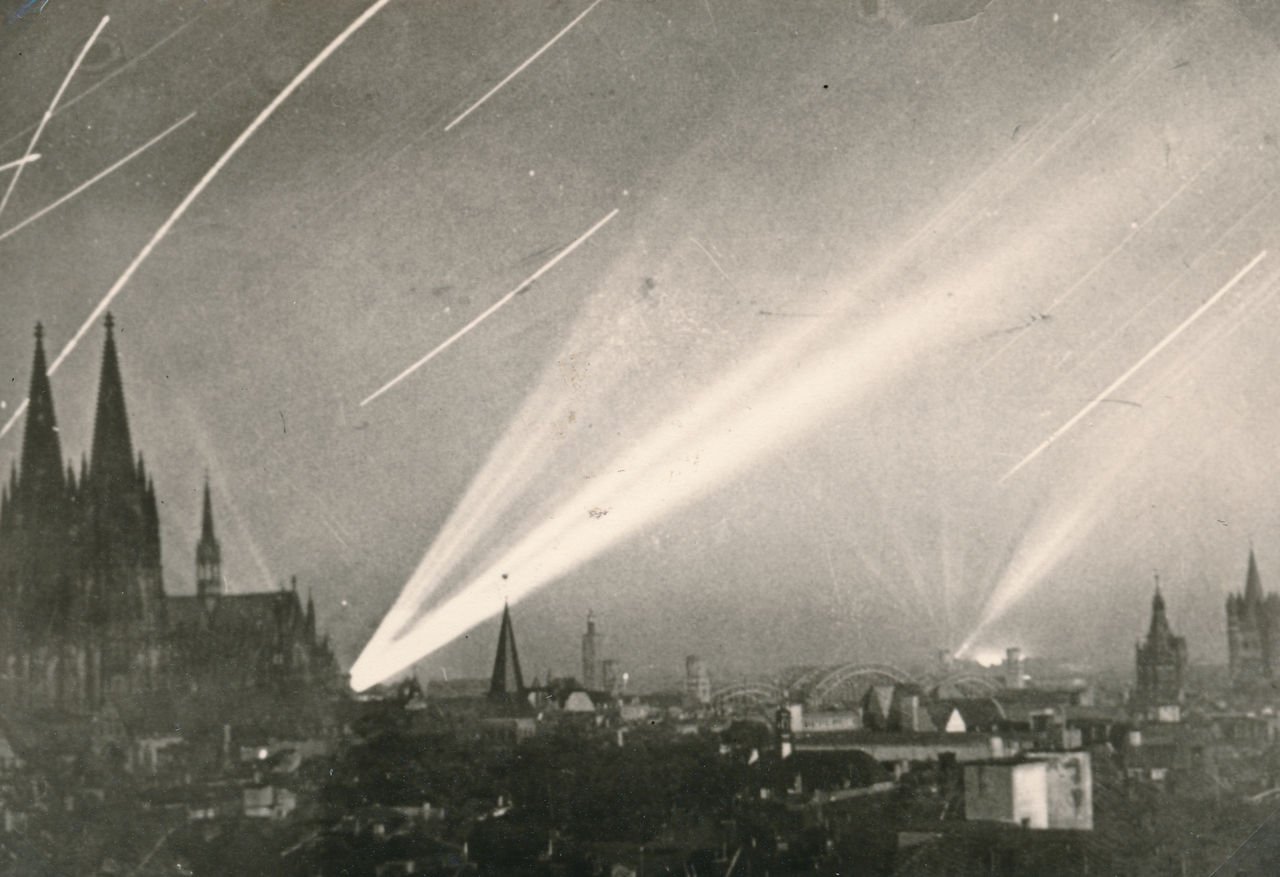
Cologne under attack by RAF bombers with the spires of Kölner Dom at left.
Cologne
As they approached the target, it got even more surreal. A low, thin haze covered the city ahead. Searchlights swept around the periphery. Probing up through the haze and whipsawing the sky with white hot light. Orange fires glowed beneath the mantle of mist while ghostly green flares from Pathfinder Force aircraft dripped lazily down on parachutes. The air had been smooth on the run in, but now it was bucking and slamming S-Sugar, sometimes lifting Billy out of his sling almost to a standing position, rocking him left and right, the result of the converging wakes of the bombers and the lingering, fractured air from flak bursts. It was hard to see the anti-aircraft fire. The flak came and went with a pale red pop all round them. They were in the flak box now, aiming for the unseen rail yards they knew were on the eastern side of the black serpent they called the Rhine. It seemed that the others didn’t care where they dropped their bomb loads, for fires burned everywhere and heavy concussive flashes erupted all over the west side of the river. Some reached all the way up here. You could feel them in the seat of your pants. There was not much he could do now but watch. The night fighters rarely ventured into the box during a raid, but they sure as hell would be waiting for them on the other side.
To his right and 12,000 feet below, he saw the black gothic spires of the Kölner Dom, (Cologne Cathedral) punching up through the smoky haze and the black shape of another Halifax backlit by the fires beneath. In the inferno’s glow, he watched the spent puffs of stationary flak smoke drifting past them. He thought of the old saying, “War is Hell” and knew he was looking down into it.
There were a few truly violent cracks from flak bursts, slamming them sideways or kicking them up. He saw still-smoking pieces of metal bounce and rattle off the fuselage ahead and spin past his turret causing him to duck. The feeling of naked exposure to the lacerating shrapnel welled up in him like death rising from a grave, coming for him. He squeezed his gun grips tighter, begging for an enemy to shoot at, wishing he could just do something, anything, to keep the nightmare at bay. And still he stayed where he was, exposed, alone, and alert to danger.
Through the interphone, he knew that Sandy, the bomb aimer, was opening the bomb doors. The doors were divided into sections—upper doors that slid up against the fuselage and lower, curved doors that slid inside the sides of the bomb bay. Billy could sense the hydraulic pumps at work. Sandy, lying prone in the nose of the aircraft, was controlling the aircraft through a running litany of commands to Wildey: “Left, left, steady… right… steady… steady” While Wildey kept his hands on the controls to fly the aircraft, he followed Sanderson-Miller’s precise directions to the letter. When his bombsight indicator intersected with the target, Sanderson-Miller pressed the controller in his hand and released the load, causing the bomber to leap upwards with the release of the more than two tons of ordnance. “Bombs gone” he called, but everyone knew that already, and then "Straight and Level". He didn't need to communicate that either. Wildey knew what he was doing. After the release, Wildey was to maintain a steady course for about 20 seconds to allow the camera to photograph the strike, which was required as proof of the mission. Those 20 seconds felt like 60 or more, so desperate were they to get out of there and make their way home. Following every release, there was a pride in a duty done, a rising but false feeling that they were over the worst of it. Outside the box, the wolves were waiting.
It’s not known what exactly happened to “S for Sugar” after the bomb run. The planned route home for the eight aircraft of 10 Squadron was briefed earlier that day—a left turn to the north coming off the bombing run, then west to Maasiek on the Belgian-Netherlands border where the lakes edging the Meuse River would be obvious to Wildey and Murphy. There, they were to make a right turn and a dash north towards Leiden on the Dutch coast between Amsterdam and Rotterdam followed by a long haul northwest across the North Sea arriving overhead Hornsea on the Yorkshire coast and turning due west for Pocklington, 25 miles inland. Wildey didn’t do that.
Sometime that night, during their turn out, gunners in Halifax “A for Annie” witnessed “a huge red flame” in the sky to the south of Cologne. There was no target there, and no one could have missed Cologne tonight ringed as it was with searchlights and burning with many fires. Had they just witnessed the end of “S for Sugar”? One of two events happened to Wildey, Billy Dubroy and the rest of the crew over Cologne that night. They may have been hit by flak and set on fire, or they may have been attacked by a night fighter.
The only thing we do know for sure is that the scattered remains of “S for Sugar” came raining down in flames out of the inky darkness over the town of Duisdorf, some 30 kilometres south of Cologne. Along the flightpath to the wreckage, five parachutes descended in silence and in darkness and the five survivors watched their Halifax, streaming flames, explode to the south, each wondering who managed to get out. Given that “S for Sugar’s” remains came down so far south, it seems most likely that they were chased there by a night fighter. Upon spotting an intruder on their tail, it was Brindley’s duty to warn the pilot, who would then immediately execute the corkscrew manoeuvre — a violent, last-resort evasive tactic used by RAF Bomber Command crews to escape German night fighters. Initiated by the rear gunner upon spotting a fighter and shouting "Corkscrew Port (or Starboard depending on the attack angle)", the pilot would execute a diving, turning, and climbing sequence in that direction to break visual or radar contact and force the attacker to overshoot, often descending 1,000 ft in seconds. If Brindley had called out “Corkscrew starboard!” he may have set them on a southerly course that led them to the sky over Duisdorf.
In the moments that followed the attack, the situation on board “S for Sugar” became untenable, most likely because a wing, engine or fuel tank was on fire and in danger of destroying the aircraft. As the Halifax began to burn, Billy would be lit by the 100-octane light, mesmerized by the sheeting white hot violence of it. If one of their four Merlin XX engines was on fire, Wildey in the forward crew compartment would have immediately ordered Burtonshaw to shut down the burning engine and feather the propeller and once that was done, to discharge extinguishing agents from bottles inside the nacelle. The fire suppression systems used on RAF bombers were designed for, and most effective, when the engine was fully shut down and the propeller stopped. As Billy likely watched in horror from his turret, a puff of methyl bromide extinguisher vapour blew dust and debris from the nacelle which whipped away in the dark. For an instant, the fire seemed to die down, but then flared up again immediately, burning even brighter, blowtorching the surface of the wing in its wake, igniting a stream of leaking fuel. Billy, from his high perch would have had an unimpeded view of the situation, better than anyone in the crew. If the engines had been air cooled radials with open maws, Wildey could have tried a high-speed dive to shear the flame away from the fuel source. But these were liquid-cooled, fully enclosed nacelles, designed to reduce drag by diverting the airflow around the engine.
There was no only a few moments left for “S for Sugar”. Realizing thisn Wildey shouted “Bail Out! Bail Out!“ over the interphone. He did this knowing his duty to his men now was to stay at the controls while the aircraft burned, thus allowing time for the others to get out. All the men in the forward compartment went out through the escape hatch below navigator Davis’ seat. Likely he was first out, standing over the open hatch as he was, followed by radio operator Harrison, bomb-aimer Sanderson-Miller and then Murphy and Burtonshaw dropping down from the upper flight deck.
The two turret gunners had the most difficult path to escape, and it’s even possible that Brindley had been wounded or killed in the attack. Rear gunners were the most vulnerable to night fighters, facing the approaching enemy aircraft with its cannon and guns blazing. Often, a blaze of gunfire was their first clue that the enemy was on their tail. Many a rear gunner died before they could get off a shot.
Dubroy had to rotate his turret to the correct position to get out. If it was damaged, he was doomed as he had to hand crank it to the correct position. Even doing so, he would still have unplug himself from the oxygen supply, the interphone and the electric supply for his heated suit, then squeeze out and drop onto the floor, grab his parachute, clip it on and head to the main crew hatch at the back of the aircraft, release it and drop out. All while Wildey in front the aircraft was fighting for control. But Dubroy and Brindley never managed to get out. Along with Wildey at the controls, they were caught in the fuselage when the aircraft exploded or came apart. From that point, if they weren’t already dead, centrifugal force prevented them from moving to the escape hatches.
Murphy, Davis, Burtonshaw, Sanderson-Miller and Harrison, with no hope of escape deep in Germany, gave themselves up or were captured. They didn’t have far to go as there was a major PoW camp right in Duisdorf-Bonn area — Stalag VI G. It was not a camp dedicated to the incarceration of air force prisoners, but it’s where they were likely taken at first. The following day, the remains of Billy, Wildey and Fred were removed from the wreckage by local police. They would be identified through examination of identity discs found in the wreckage, but it’s likely their remains were dispersed and indistinguishable from each other, as they were buried together in a single grave. When a plane exploded, crashed at high speed, or burned, it was frequently impossible to separate the remains of the crew. If bodies were severely damaged or intermingled, they were buried together. It was even a common, respectful practice to bury a full crew in a single grave, especially if they could not be identified individually, as a way to honour their shared service and sacrifice. They were buried locally and then their remains moved after the war to
In the days following the crash, a Luftwaffe salvage crew sorted through the remains of S for Sugar, checking first for anything that might be new technology and documents and maps that might reveal raid planning aspects or routing. Then they craning the collapsed hulk onto a flatbed to be taken to a salvage yard. Eventually the aluminum body of the once-formidable machine was guillotined and melted down to make aluminum ingots. These, in the months ahead, would become part of the Nazi war machine — perhaps to fly again, perhaps ground to powder to be used in the manufacture of trialen, or mixed with hexogen, to form the explosive used in flak ammunition. Either way, the wreck of S for Sugar, might soon take another Halifax with it.
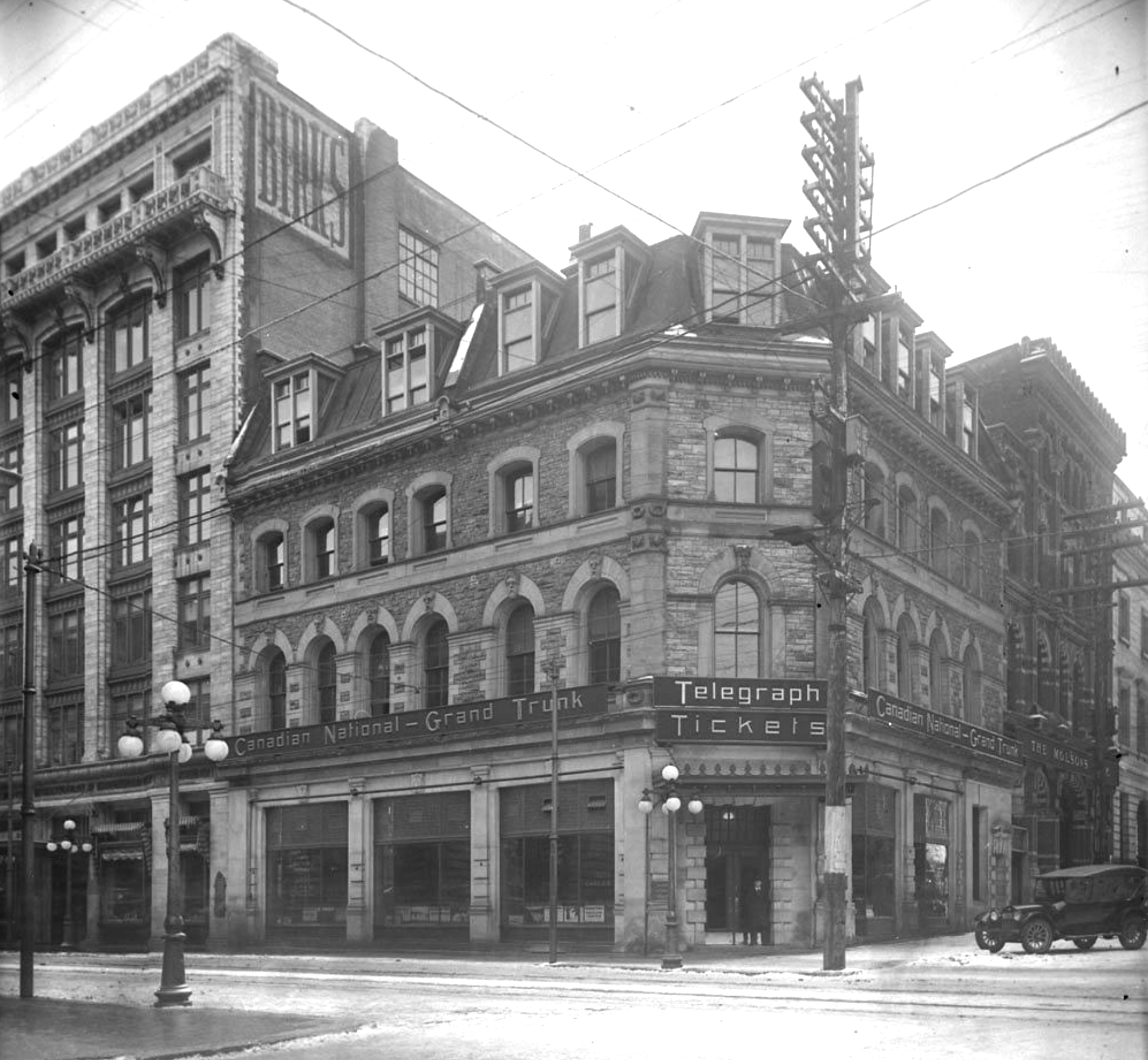
The Canadian National Telegraph and Cable Company’s office at 93 Sparks street.
Sign here, please.
Two days after the destruction of “S for Sugar”, while salvage crews at the crash site in Duisdorf inspected the broken aluminum bones and lacerated, burned skin of S for Sugar, an automatic teleprinter at the Canadian National Telegraph and Cable (CNT&C) office at 93 Sparks Street in Ottawa began clacking and whirring away, translating a Morse-coded message from RCAF Headquarters a few blocks away. It converted the dots and dashes into all-caps and unpunctuated words printed on a narrow ribbon of thin adhesive-backed paper measuring 3/8 of an inch wide. The ribbon was pulled from a vertically mounted roll at the top of the machine. After about 60 inches had rolled off, the machine stopped abruptly and the tape shot forward an inch or two, signalling the end of the message. Sitting in front of the machine was an operator who took a standard message form from the pile next to her, placed it on the table, and clipped off part of the message with the addressee’s name and street address, ran it through a wetting cylinder and pressed it onto the top left corner of the form. She then clipped off the first part of the message, wet it, and making sure that no word was cut in two and that it was never longer than 7 1/2 inches, placed the start of the message to the far left on the blank form and pressed it down with a dry sponge. Immediately below that she placed the start of the next strip, and then the next until she ran out of message. Then she took her roller date stamp with 1942 OCT 15 set earlier in her shift, opened her ink pad and thumped the rubber stamp onto it. Then taking the telegram in her left hand, she carefully pressed the date in the upper right corner below the CNT&T masthead. Then she took out the time stamp, looked up at the clock on the wall and rolled in the new time, and pressed it next to the date.
She sighed when she looked it over. More than once before, she had recognized the name of the boy whose parents were going to be crushed by the contents of the message. Business at the office was brisk since the war started—men letting their parents, wives and lovers know they had arrived safely overseas, that they were shipping out again for the Far East or the Mediterranean or perhaps wishing a wife a happy anniversary. On the other hand, there were increasingly more of these utterly devastating messages, which seemed all the worse because they were spitting out of an unthinking machine. Gently, almost reverently, she blew the ink dry and folded the message, placing it in a window envelope with the address displayed, got up from her desk and handed it to the dispatcher who took it and several more from the counter to a room where a few telegraph boys sat waiting. The dispatcher handed them to the boy who was first in the queue and he reviewed the addresses, looking for the nearest and placed them in his canvas shoulder bag. He turned and left quickly via a door that opened onto Metcalfe Street The boy knew that the faster he delivered these telegrams, the quicker he could be back for more and he was paid by the delivery—six cents for most downtown addresses, and if he was lucky, 25 cents to deliver one out to Westboro or Britannia.
He stepped out to his bicycle leaning against the wall in front of several cars angle-parked into the sidewalk on Metcalfe. At 15º C, it was cool and clear, a lovely late autumn day. A good day for cycling he thought, but it was always a bad day if he held unwanted news in his bag. He understood he was likely carrying important news but had no idea whether it was good or bad. He was obligated to get a signature, and he hated the haunted looks on the faces at the door, the shaking hand signing. He didn’t think about it today, but long after the war when he became a man, he would think about these days, about being a silent witness to history and remember feel of the sad weight of every envelope.
He pushed off, threw his leg over the seat and, bumping over the streetcar tracks on Sparks Street, coasted down Metcalfe Street all the way to Laurier Street, turning left towards Elgin Street where there was a traffic circle he could use to avoid stopping. He cranked hard to fit into traffic and turned right at the roundabout. The white bulk of the just-finished wooden “temporary buildings” housing the wartime headquarters of the Department of National Defence spread across blocks to his left. He could smell the Douglas fir and white pine still piled on the site. Everywhere he looked, he saw men and women in navy, army and air force uniform, looking purposeful and dramatic. If the war lasted, he hoped to enlist in the air force, but for now his CNT&C cap and tie were his uniform. Pumping hard, he turned left again a few blocks later onto Somerset and then right onto Cartier Street, lined with new three- and four-storey fore-courted apartment blocks and stately elms. He pedalled through a blizzard of their falling leaves blowing yellow across the street in the late morning breeze. He rode past the looming Romanesque Revival bulk of St. Theresa’s standing on a podium high above the street. Looking left at the odd-numbered homes he began searching for 109 Cartier Street, the home of a Mr. William Dubroy.
Cycling a few more blocks, he found 109 at the northeast corner of Waverley Street. He set his bike against a hydro pole and marched smartly up the walk, pushed his peaked cap off the back of his head, straightened his tie and rapped on the door. A few moments later the door opened to an older woman who looked at him warily from the gloom. “Telegram for Mr. William Dubroy!” he said as cheerfully as possible. “He’s not home” said the woman, “but I’m his wife. I’ll sign for it.” “Good enough.” thought the boy and whipped out his delivery book from his bag, and pointing to the appropriate space held out a fountain pen from his shirt pocket saying, “Sign here, please.”
As soon as she signed, he thanked her and wasted no time getting out of there. He knew in his heart what that telegram might say. There was not a word from the old woman and the door snicked shut behind him. Out on the street he sorted through his other envelopes. Among a few business addresses, he found two that he knew from experience could contain bad news as well: one for a Mrs. John M. Joynt* at 190 Preston Street and another for a Mrs E. Stewart** who lived south of Billings Bridge on Wildwood Street. If there wasn’t a delivery charge to collect or the need take down a return message, these letters to the lady of the house felt ominous to him, seemed heavier, were filled with a black possibility. He unfolded his map, found the location near Billings Bridge. He would deliver a few in town as he pedalled out to Preston, then double back to Bank street and on south to Billings Bridge across the Rideau River, hoping for a 25 cent reward for the remote address.
Just as he pushed off, he thought he heard a woman wail in grief behind the door of 109 Waverley.
By Dave O’Malley, March, 2026
* Mrs John M. Joynt, a widow, was the mother of John Millar Joynt, a Wireless Operator/Air Gunner air gunner on a 420 Squadron Vickers Wellington that failed to return from a bombing op to Cologne—the same raid that took the life of Billy Dubroy. They likely crashed into the North Sea after being hit by flak or a night fighter.
** Mrs. Eleanor Stewart was the mother of Flight Sergeant Douglas Harrison Stewart, an RCAF pilot who flew with No. 296 Squadron, a unit which flew Whitley bombers to tow gliders with combat troops or as parachute assault troop carriers. He was killed on the same day as Billy whilst flying an Airspeed Horsa glider at the Glider Pilot Exercise Unit. He was likely an instructor training Army pilots.
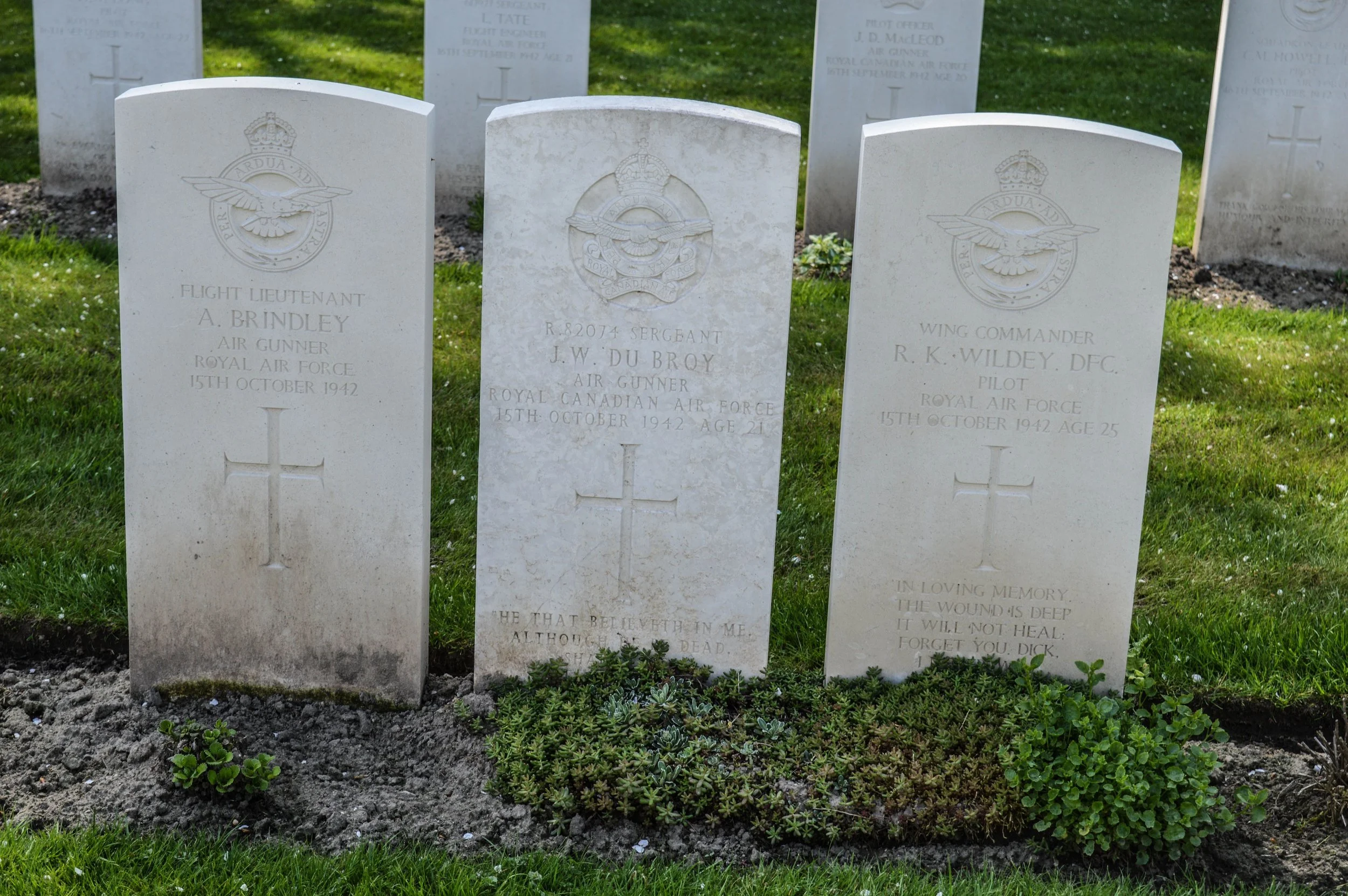
The three were initially buried in the nearby Duisdorf Cemetery, about 20 miles south of Cologne. On 12 April 1947, they were re-interred in the Rheinberg War Cemetery, 50 miles north of Cologne, which holds 3,300 Commonwealth Second World War casualties. The widowed Eileen Wildey took the option of adding a personal inscription to his headstone on collective grave 5.D.16-17, “In loving memory. / The wound is deep / it will not heal; / forget you, Dick, / I never will.”
Appendix
A lot of what I find in researching these stories cannot be used in the stories them selves, but perhaps this following appendix of sorts will help keep that information in daylight for future researchers.
A little more detail on the life of Billy Dubroy
Billy was born on September 20, 1921, in the small rural hamlet of Dwyer Hill, Ontario, now the home of The Dwyer Hill Training Centre (DHTC), the primary base for Canada's elite special forces unit, Joint Task Force 2 (JTF2), focusing on counterterrorism and special operations. Back then, Dwyer Hill consisted of a few houses, a schoolhouse and a Catholic church and was largely populated by Irish immigrants whose ancestors arrived in Canada long before the potato famine of 1845. His mother, Anna McKenna was from Dwyer Hill and his father from another nearby and larger farming community called Richmond. His grandfather William changed the spelling of his original French name from Dubreuil to Dubroy somewhere along the way. Perhaps to make spelling easier in an all-English community.
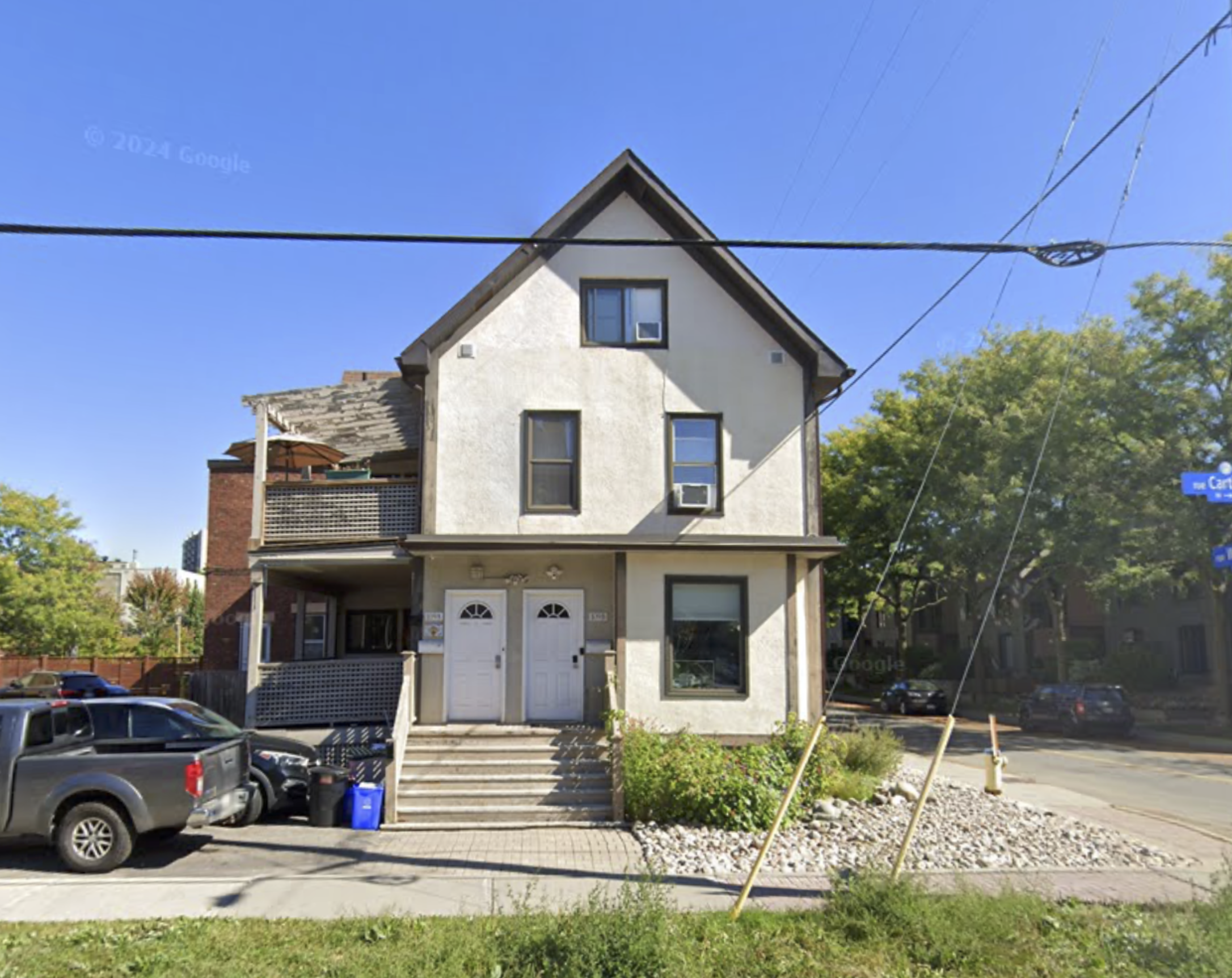
Billy’s childhood home at 109 Cartier Street at the corner of Waverley Street still exists.
He was the youngest of six children — Wilfred Joseph (born 1908), Francis Lawrence (1912) and Thomas Edmond –Tommy— (1917) and two sisters Nora Mary (1909) and Helen Margaret (1913). They attended St. Clare Mission church which still exists today — a unique, architecturally significant building designed by Francis Sullivan, a pupil of Frank Lloyd Wright.
The family moved to Ottawa where his father, William Dubroy took a job as a street car conductor for the Ottawa Electric Railway. They lived in a humble frame house at number 109 Cartier Street in downtown Ottawa, just a few blocks from Parliament Hill. He attended St. Patrick’s elementary school on Nepean Street, across from St. Patrick Basilica and then St. Patrick’s College, a Catholic high school run by Oblate priests and brothers on Echo Drive along the Rideau Canal, each within a 20-minute walk from their home. Though school was close to the glorious basilica, the family were members of St. Theresa Church, just a few blocks from their home.
Billy first tried to enlist in February 1940, but It seems he had not impressed the medical examiner who felt he was too frail to be of service. He was slight in stature—5’-5” tall and barely topping 120 lbs soaking wet. With his pale complexion, red air and grey eyes, he was not the recruiting poster kind of airman. The following May, a family friend, Flying Officer G. J. Moon, telephoned and wrote to the recruiting officer after Billy’s first interview stating: “His mother informs me that he has gained weight since the last medical examination and also, in conversation with the boy, he is willing to be trained as a Wireless Mechanic. Anything you can do for the lad with be greatly appreciated by the undersigned.”
Billy was finally accepted and filled out his attestation papers a few days after Moon’s letter was received by the recruiting office. He put down on his attestation form that he enjoyed football, hockey, baseball and skiing… all the things that his older brother Tommy excelled in. Tommy was also skilled at building model aircraft and Billy put the same thing down on his form. One reads from this that Tommy, a well-known rowing, football and skiing star in Ottawa whose accomplishments were reported almost weekly in the local broadsheet newspapers, was his hero. His older brother Frank was already serving with the Royal Canadian Navy Volunteer Reserve in Halifax, Nova Scotia… as a “writer” of all things.
Bill still had to wait several months before his orders and travel chit arrived to report to No. 2 Manning Depot in Brandon, Manitoba where he was given his first uniform and made Aircraftman Second Class (AC2), the lowest of rungs on the RCAF ladder. No. 2 Manning Depot was where many young recruits destined for air gunnery and wireless training went upon enlistment. After a month there (learning to march, take care of his kit, basic RCAF rules and regulations and physical training) he left for No. 3 Service Flying Training School (3SFTS) in Calgary, Alberta. Here he stood “guard duty” or “tarmac duty”, an often-meaningless set of duties designed to keep recruits busy until a spot opened at the next stage of their training. After three months of wintry and otiose duty, he left No. 3 SFTS for Initial Training School in Regina where his aptitude for aircrew duties would be assessed.
He was at Regina for a month and a half, before being posted back to Manning Depot in Brandon, where he waited for two whole months. Perhaps he was held there until a spot opened at No. 2 Wireless School back at Calgary, or perhaps he needed some remedial airman training. Going back to Manning Depot was, in my experience, irregular. Regardless, he was eventually posted to No. 2 Wireless School in Calgary. Despite taking the full course and getting a two-month extension and extra training, he failed out and left in shame in January 1942 for RCAF Trenton’s No. 1 Composite Training School for reassignment. Two months later he left for No. 4 Bombing and Gunnery School in Fingal, Ontario on the shores of Lake Erie.
He earned his gunner’s wing on April 14, 1942, and was granted two weeks of embarkation leave to visit his family before reporting to Y-Depot in Halifax for transport overseas. He arrived at No. 3 Personnel Reception Centre in Bournemouth, England on May 15 and lived for the next month in a hotel requisitioned by the RCAF, awaiting a posting. On June 20, he was posted to No. 7 Air Gunnery School a RAF Stormy Down in Glamorgan, Wales. More than 7,000 Air Gunners were trained there from the ground up on courses lasting up to seven weeks. But Billy already had his brevet. He was there to learn to use the Boulton Paul four-gun and two-gun turrets presently being used in the new generation four-engine bombers of Bomber Command. Four weeks later he entrained for No. 10 Heavy Conversion Unit on Jul 14 to train as part of a Halifax bomber crew. On August 8, just two months before the Cologne raid, he joined 10 Squadron, Royal Air Force.
Wing Commander Richard Kemp “Dicky” Wildey, DFC.
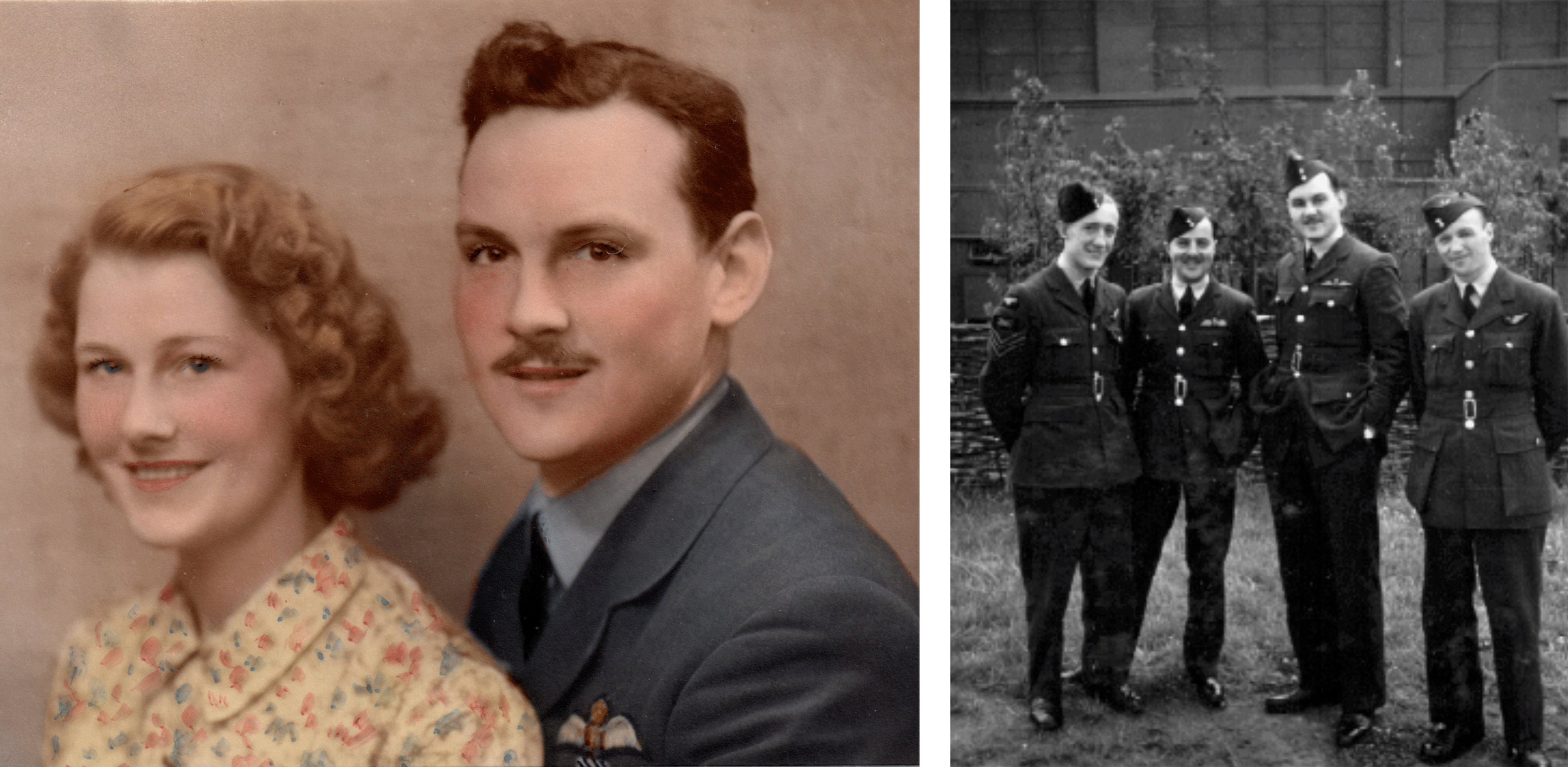
Dicky Wildey and his wife Eileen after receiving his DFC. Right: Dick (second from left) with pals at 78 Squadron.
Richard Kemp Wildey, Dicky to his friends, was born in London, November 6, 1916, the son of Harold and Lottie Kemp. In 1926, he attended the much-respected Emmanuel School in Battersea. Hi obituary in The Portcullis, the organ of Emmanuel School, stated that “although he did not shine in his school work, or at games for that matter, was universally popular because of his charming and unassuming manner.”
In the school’s cadet corps, he was outstanding and held the rank of Cadet Sergeant Major. According to The Portcullis:
“In the school workshop, too, he was in his element, and before long, any show be it for Parents’ Night or the School Play, was incomplete without Dick Wildy behind the scenes. He also appeared on the stage on occassion. As a mimic he as extremely good; in a form [class] of unusually lively characters, he was outstanding.”
Wildey took a short service commission with the RAF and flew Armstrong Whitworth Whitleys with 51 and 78 Squadrons. As an Acting Squadron Leader, he was awarded the DFC November 22nd, 1940 while with 78 Squadron after completing 13 ops in just 27 days. Following his time with the squadron, he received a posting to RAF Bomber Command Headquarters Staff under Air Vice Marshal Coningham.
In October 1941, he married Eileen Marjorie Hoare. Just a few weeks before his last op, Dicky Wildey learned that he was to be a father. His son Peter was born six months after his death.
In June of 2013 K. Hayton posted on the blog page of Wing Commander Wildey’s alma mater Emmanuel School in Battersea:
“My father, F/O J W Murphy, was flying with W/C Wildey on the night of October 15th, 1942. When the plane was hit, W/C Wildey held the burning aircraft steady so that the others could bail out. My Dad spent the rest of the war in Stalag Luft 3. I would not be here today, but for W/C Wildey’s bravery. Please convey my heartfelt thanks to his family.”
Allan Fred John Sanderson-Miller
In 1945, Sandy, the crew’s London-born Bomb-Aimer was released from Luft L3 Sagan and Belaria, the same camp where the famed “Great Escape” took place. During his incarceration he was promoted to Pilot Officer and upon repatriation, he remained in the Royal Air Force. He was promoted to Flight Lieutenant and gazetted in June of 1949. He spent some time in Hong Kong before moving to Australia where he died in Joondalup, Western Australia at the age of 85
Frederick Esmond Perry Burtonshaw

Fred Burtonshaw (second from right in back row) and some of his comrades. Right: the cover of his memorial service program featuring a painting of a Halifax taking off got an op.
After his liberation from Heydekrug PoW camp, Fred, the crew’s Flight Engineer lived a full life until close to the end, dying of Alzheimer’s in 2006 at the age of 86. He was cremated at King’s Lynn, Norfolk, England. The program from the celebration of his life featured a painting of a Halifax bomber lifting off into sunny skies, a testament to the power those days held for the rest of his life.
Likely this was the same for all the crew who survived. Though they all went on to live fulsome lives in peace, those days on squadron would be, forever more, the most powerful experience they would ever have, filling their dreams, their memories and hearts. Though, like most who survived, Fred Burtonshaw probably didn’t brag and put himself at the centre of the war, his family understood the hold it had on his memory even though he may have been suffering from Alzheimer’s. (The backside of his memorial service programs suggested that donations to the Alzheimer’s Society could be made in lieu of flowers.)
Pilot Officer James Wilfred Murphy
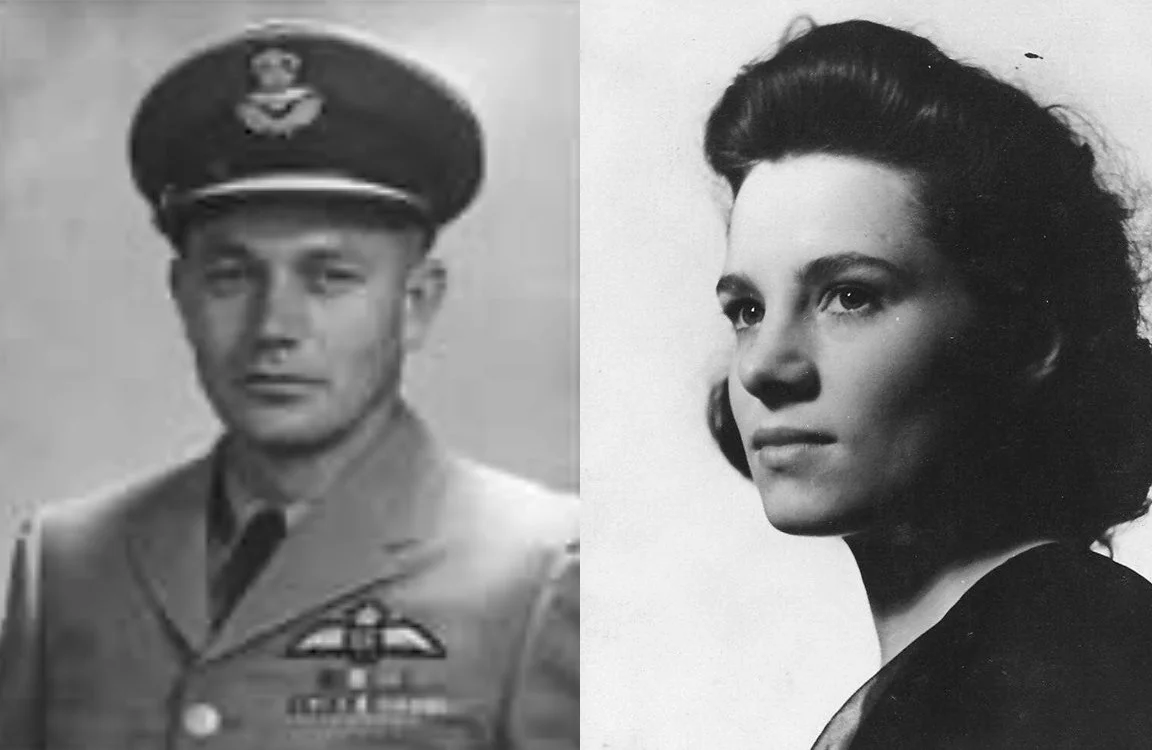
Flight Lieutenant James Wilfred Murphy and his wife, the former Patricia Eileen Gertrude Ryan of London. Image via Ancestry.com
Jim Murphy, who was the Second Dickey Pilot aboard Halifax W1058 that fateful night over Cologne, was born in Newdale, Manitoba in 1916. He spent his early life there and attended University of Manitoba in Winnipeg. His father died in 1925 in Toronto and for his next-of-kin he listed Chief Petty Officer and Mrs. James H. Nixon of Owen Sound. Mrs. Nixon was the former Mrs. Murphy and his mother.
He was freed from PoW camp at Stalag Luft L3 Sagan and Belaria and was reported safe in England in May 1945 at the age of 28. His rank was then Flying Officer.
Though his next-of-kin were from Owen Sound, he had no ties there, having never been there before. Shortly after arriving back in England, Murphy married Patricia Eileen Ryan of Kent and remained in Great Britain after the war. It’s clear that he remained in the RCAF for there is a portrait of him in uniform with this Second World War campaign medals. Two years later he is noted in Ancestry.com to have arrived by car with his wife at the border crossing in Sweet Grass, Montana in February 1947. His customs papers indicate that he was a Flying Officer on the RCAF. It also showed that he was living in Edmonton, Alberta. He and Patricia were on a 29-day driving adventure visiting a friend in Los Angeles.
Next to Edmonton on his form, was written the acronym NWAC for North West Air Command. North West Air Command (NWAC) was a major RCAF command formed in June 1944, and headquartered in Edmonton, created to manage operations and air routes in Northwestern Canada and the Yukon. It played a key role in regional defence in the Second World War, supporting Alaska operations and managing stations in communities like Whitehorse.
Two years later, on Christmas Day, a daughter, Holly Patrica was born, likely earning her name from her auspicious birth date. In April 1952, the family was in Summerside PEI.
Murphy’s daughter died at age 32 in Cape Town, South Africa in 1981. Murphy himself died in 1995 at the age of 78 in Worthing, West Sussex. Patricia lived another 11 years dying in Horsham, Sussex in 2006.
In June of 2013 someone posted on the blog page of Wing Commander Wildey’s alma mater Emmanuel School in Battersea:
My father, F/O J W Murphy, was flying with W/C Wildey on the night of October 15th, 1942. When the plane was hit, W/C Wildey held the burning aircraft steady so that the others could bail out. My Dad spent the rest of the war in Stalag Luft 3. I would not be here today, but for W/C Wildey’s bravery. Please convey my heartfelt thanks to his family.”
It was signed K Hayton, perhaps a daughter not listed on ancestry.com. On Murphy’s page on ancestry.com there is one other unnamed child listed, but with privacy protection. Perhaps this is her post.
Flight Lieutenant Michael McFarland Davis
Mike Davis was born in 1919 in Lambeth, Surrey, England. In the 1939 England and Wales Register, he is listed in Hendon as a clerical officer at the Air Ministry. He was married to Aline Butler just three months before the night he bailed out of Halifax W1058. He spent two and a half years at Stalag Luft L3 Sagan and Belaria. Not much is known of his life, or at least available online, but he died in Abingdon, Oxfordshire in 2007 at the age of 88.
Sergeant C. E. Harrison (E is for Enigmatic)
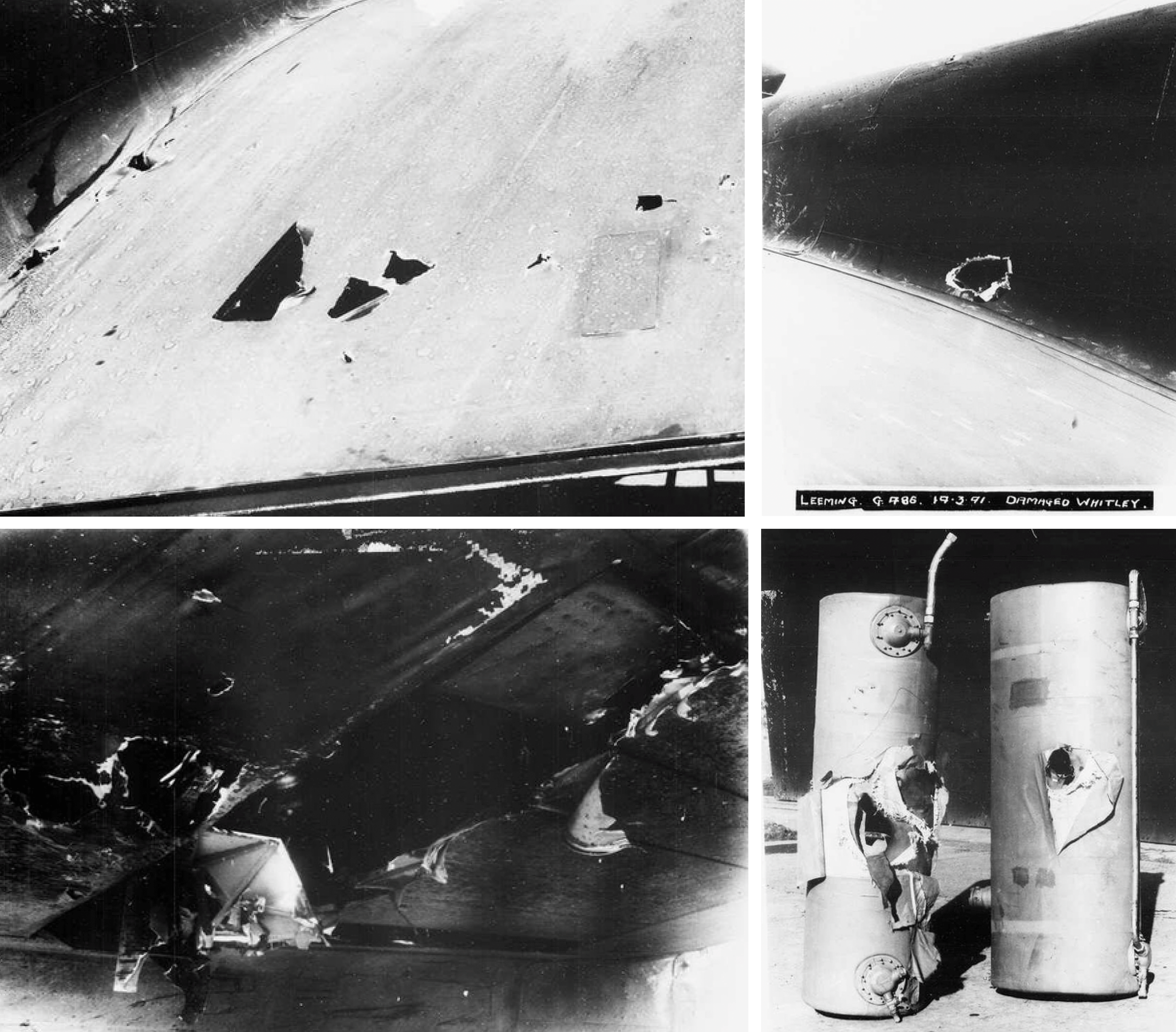
Photos of the damaged sustained by Harrison’s Whitley on the March 14, 1941 raid on Rotterdam. Image from ORB
Not much is available online concerning the personal life of C. E. Harrison, the crew’s radio operator, not the least of which is the names behind his initials. Despite knowing little about who he was, I can at least trace his service. I found his name and service number as far back as January 20, 1941 as part a crew in training on Armstrong Whitworth Whitley bombers with 10 Squadron (Crew commander: Pilot Officer William Desmond Boxwell). Three days later the Boxwell crew was made operational. Harrison was listed as 2nd W/Op and in fact all the crews on the squadron had two wireless operators. One likely manned the rear guns. They continued on a training schedule well into March. Their crew was listed on the 10 Squadron order of battle among the “nursery crews”. "Nursery" operations in RAF Bomber Command during the Second World War refers to the use of specific, less-dangerous minelaying missions to train new, inexperienced aircrews. These operations were a crucial part of the "gardening" campaign (the code name for aerial minelaying) which, while considered safer than bombing heavily defended cities, still involved significant risk and losses.
Rather than go too deeply into his extraordinary combat career, Harrison had been with the squadron a few months short of two years, a long time to remain alive in those years. He served as wireless operator on crews commanded by Boxwell, Pilot Officer W. Freund., Sergeant Bigglestone, Squadron Leader Carter and Wing Commander Wildey. He flew on both the Whitley and Halifax. He survived raids on Rotterdam, Hamburg, Kiel, Boulogne, Bremen, Emden, Dusseldorf, Dortmund, Mannheim, Essen, Cologne, Saarbrucken, and several targets with just a code name (usually sewing mines in estuaries) — several of them more than once.
If anyone can offer up an image of the man or his name, I would be so appreciative.
